Instantly Review 2026: Best for Scaling Cold Email Across Multiple Inboxes?
· 16 min read · By Marwene Amor
Quick answer: Instantly is a cold email sender built for operators running many inboxes at once, with entry pricing around $37/mo, unlimited connected mailboxes, and a bundled warmup network. Best for lead-gen agencies, founders sending 500+ emails per day, and teams managing multiple sending domains. Not for solo operators with a single inbox or teams needing deep 1:1 personalization, where lemlist fits better. One signup gotcha: the trial verifies a real company website, so solo founders without a formal site can get blocked and should start on Snov.io or Smartlead instead.
- Tested Instantly's new AI agent stack hands-on the day after the Lead Agent launch: AI Sales Agent, Lead Finder Agent, agent pricing in credits, and the defaults you should change. Eight fresh screenshots from our own workspace.
- Documented the gap between "agent activated" and "agent operational": nothing runs until you connect a sending mailbox.
- Earlier updates: per-plan pricing breakdown, deliverability section, lemlist/Apollo comparison table, common-mistakes section, twelve-question FAQ with structured data.
Instantly is the cold email platform that has built its reputation on one specific promise: send cold email at scale without burning your sender reputation. The product positions itself as the operator's choice for high-volume outreach, with unlimited inbox connections, a large built-in warmup network, and a campaign engine that handles multi-domain rotation natively.
This review covers what Instantly is, who it's actually built for, how its pricing breaks down plan by plan, how it protects deliverability, and how it stacks up against the other two tools most operators consider at the same time: lemlist and Apollo. We also walk through the interface using screenshots from our own exploration of the product.
Quick verdict: Instantly is the strongest choice for B2B operators and agencies sending cold email at scale across multiple inboxes and sending domains. If you're a solo founder with one mailbox, you can pick almost anything. If your business runs outbound at scale, Instantly is built for you.
Instantly at a glance
| Attribute | Detail |
|---|---|
| Best for | Agencies and operators sending at scale across many inboxes and domains |
| Starting price | Around $37/mo (Growth), unlimited inboxes included |
| Free trial | 14 days |
| Standout feature | Unlimited connected inboxes plus a bundled warmup network |
| Weak spot | Overkill for single-inbox senders; personalization is shallower than lemlist |
| Our take | The most defensible default for serious, high-volume cold email in 2026 |
Who Instantly is best for
Instantly's product decisions consistently optimize for one persona: the operator running cold email as a serious channel rather than a side experiment. That shows up in four concrete groups:
- Lead-generation agencies managing outreach for multiple clients. The unlimited-inbox pricing means you can run campaigns for 5 to 20 clients without per-seat penalties.
- Founders sending at scale. If your motion is 500 or more cold emails per day, the multi-inbox rotation and built-in warmup keep deliverability sustainable in a way single-inbox tools struggle to match.
- Teams managing multiple sending domains. Instantly is designed to treat several domains as one campaign system rather than separate accounts.
- Operators who care about deliverability mechanics. The dashboard surfaces warmup activity, account health, and inbox placement signals where competitors hide them.
Who should skip Instantly
Instantly is opinionated, and that opinion doesn't fit every workflow. Look elsewhere if any of these describe you:
- You only need one inbox. Sending from a single mailbox at low volume is overserved by simpler tools.
- You need deep one-to-one personalization. Instantly supports merge tags and conditionals, but lemlist is more sophisticated for image personalization and account-based-style sequences.
- You want a built-in contact database as your main feature. Apollo bundles a 275M-contact database with a sender. If data is the bottleneck rather than sending, Apollo's all-in-one model can be more efficient. See our finder comparison if data quality is your primary concern.
- You're not doing cold outbound. Instantly is purpose-built for cold email. For newsletter sends or marketing broadcasts, traditional ESPs fit better.
Before you sign up: what Instantly checks at the door
Instantly runs a signup filter most reviews don't mention. When you create an account, they ask for your company website and verify that the domain is real, active, and looks like a business. If you're a solo founder without a formal site yet, a freelancer testing before recommending to a client, an SDR evaluating tools before pitching internally, or anyone with a Gmail-only footprint, you'll likely get blocked at signup.
This is deliberate. Instantly's sales team focuses on established outbound operations with five-plus inboxes and real send volume. The filter keeps the free trial clean of tire-kickers. Fair as a business decision, worth knowing before you invest twenty minutes reading a review and hit a wall at signup.
If the filter blocks you and you still need to make progress today, two tools open the door immediately:
- Hunter. Free Chrome extension, 25 email searches per month, no company website required at signup. If your bottleneck is finding contacts (usually the first blocker), Hunter solves that layer without friction. Signup takes one email and one password. Try Hunter free →
- Snov.io. Free tier bundles 50 credits per month across finder, verifier, and a light cold-email sender. Company website field is optional. If you want to actually send from day one without qualifying, Snov ships that today. Try Snov free →
Not sure which fits your workflow? Our email finder guide compares Hunter, Snov, and the rest side by side, with the trade-offs stated plainly.
What Instantly actually is
Instantly launched as a cold email sender focused on a single hard problem: letting one operator run many sending inboxes at once without each one drifting into spam. Most outbound tools were built around the assumption that a user connects one or two mailboxes. Instantly was built around the assumption that a serious operator runs anywhere from five to fifty inboxes spread across multiple sending domains, and rotates volume across them so no single mailbox ever looks unnatural.
That assumption shapes the whole product. Warmup is bundled rather than sold separately. Inbox connection is unlimited rather than metered per seat. The analytics are built around per-inbox health, not just per-campaign totals. If you read the product as a generic email tool it looks busy and over-engineered. If you read it as an instrument for high-volume outbound, the density makes sense, because every screen is built for the operator who treats deliverability as a daily discipline.
The trade-off is that Instantly is a sender, not a data platform. It has a lead database on higher tiers, but its center of gravity is sending, rotation, and warmup. If your hardest problem is finding contacts rather than reaching them, a database-first tool like Apollo will feel more complete, and a dedicated finder like Hunter or Snov.io will feed cleaner lists into Instantly than its native enrichment does.
Pricing breakdown by plan
Instantly publishes its pricing on its website and adjusts it over time, so treat the exact dollar figures below as current-as-of-June-2026 reference points and verify before you subscribe. The plan structure has been stable: three published tiers, each with unlimited connected inboxes and the native warmup network included.
| Plan | Price (monthly) | Inboxes | Active contacts | Monthly emails | Notable additions |
|---|---|---|---|---|---|
| Growth | $37 | Unlimited | 5,000 | Standard sending | Bundled warmup, core campaign engine |
| Hypergrowth | $97 | Unlimited | 25,000 | 100,000 | Lead database access, higher limits |
| Light Speed | $358 | Unlimited | 100,000 | 500,000 | Dedicated customer success manager |
Growth (around $37/mo)
The entry plan is the one most solo operators and small teams start on. It includes unlimited connected inboxes, the bundled warmup network, and the full campaign engine. The cap that matters here is the active contact allowance rather than the inbox count. For a team validating outbound or running a few hundred sends per day, Growth is enough, and the unlimited-inbox inclusion already gives it an edge over per-inbox competitors at this price.
Hypergrowth (around $97/mo)
This is the plan most scaling teams settle on. The contact allowance jumps to 25,000, monthly sending rises to around 100,000 emails, and you get access to the built-in lead database. For an operator running multiple domains and several active campaigns, Hypergrowth is the sweet spot where the unlimited-inbox model pays for itself against tools that charge per seat.
Light Speed (around $358/mo)
The top published tier is for teams sending real volume: 100,000 contacts and up to 500,000 monthly emails, plus a dedicated customer success manager. Most readers of this review won't need it, but agencies running outreach for many clients at once will recognize the math: one Light Speed seat with unlimited inboxes can replace a stack of per-inbox subscriptions that would cost far more.
The value question isn't whether Instantly is cheap. It's whether the unlimited-inbox model saves you money once you're sending at scale. For an agency running 25 inboxes for clients, the math is dramatically in Instantly's favor compared to per-inbox competitors. For a solo founder running one inbox, the price difference against alternatives narrows, and the decision comes down to whether you value the bundled warmup and per-inbox analytics.
Verify the current pricing on the official site before subscribing. Plans and prices can change.
Check Current Pricing on Instantly →
Pricing by use case
Headline prices only tell you so much. What matters is what the bill looks like for your actual sending shape. Three common profiles:
- Solo founder, one or two inboxes, around 100 emails per day. The Growth plan at roughly $37/mo covers this comfortably. At this volume the unlimited-inbox benefit is mostly latent, so the real reason to pick Instantly here is the bundled warmup and the room to scale without switching tools later.
- Small team, five inboxes, around 500 emails per day. This is where Instantly's flat pricing starts to bite for competitors. Five inboxes on a per-seat tool can climb fast, while Instantly keeps inboxes unlimited. Growth or Hypergrowth depending on contact volume, so call it $37 to $97/mo for the whole operation.
- Agency, 25 inboxes across many client domains, 2,000 plus emails per day. This is the profile Instantly was designed for. Hypergrowth or Light Speed depending on send volume, and the comparison against per-inbox pricing is not close. An equivalent per-seat setup on a personalization-first tool can run several times higher.
Deliverability: how Instantly protects sender reputation
Deliverability is the entire reason Instantly exists, so it's worth being concrete about what the product actually does to keep cold email landing in the inbox. None of this is magic. It's a set of mechanics that reduce the ways a sending account can look suspicious to Gmail and Outlook.
Built-in warmup network. Every paid plan includes warmup, where your inbox sends and receives natural-looking messages with other accounts in Instantly's network. Recipients open, reply, archive, and mark as important, which builds a sending history that looks like normal human correspondence. Volume ramp is configurable per inbox, and warmup keeps running at a low level even during active campaigns, which is the part most operators forget to do manually.
Inbox rotation. Rather than pushing all volume through one mailbox, Instantly spreads a campaign across every connected inbox, so each one stays under a natural daily ceiling. This is the single most important structural defense against the volume spikes that trigger spam filters, and it's why the unlimited-inbox model is a deliverability feature as much as a pricing one.
Authentication checks at onboarding. When you connect a mailbox, the wizard checks SPF, DKIM, and DMARC and flags missing records before you send. It won't write the records for you, but it stops you from launching a campaign on a domain that fails authentication, which is one of the most common silent causes of spam placement.
Conservative sending controls. Random delays between sends, working-hours scheduling, daily caps per inbox, and automatic stop-on-reply all ship as defaults. These are the behaviors that separate a legitimate sender from a blast, and Instantly turns them on by default rather than burying them in settings.
What Instantly cannot fix is a bad list, weak copy, or a domain you torched before you started. Tools manage the variables you control. They don't rescue the ones you ignored. For the full pre-flight routine that pairs with any sender, see our cold email deliverability checklist.
What we reviewed hands-on
We explored Instantly's interface end-to-end inside our own account. We did not launch live outbound campaigns from EmailToolsHub's main domain, since the site domain is intentionally kept clean for site traffic rather than cold sending. What we examined:
Campaigns dashboard
The Campaigns view is the operational heart of the product. Each campaign shows status, sending volume, replies, opens, and bounce indicators in one row. Creating a new campaign opens a guided flow that handles sequence steps, scheduling, sender rotation, and the most-common deliverability defaults: random delay, working-hours sending, and automatic stop on reply.

Email accounts and inbox connection
Inbox connection supports Google Workspace, Microsoft 365, and custom SMTP or IMAP. The wizard checks SPF, DKIM, and DMARC during onboarding and flags missing records before you start sending. Once connected, each inbox gets a per-account warmup setting for volume ramp, reply rate, and a weekday-only toggle. This is where Instantly's built-in warmup becomes useful: rather than running a separate $15-per-month per-inbox warmup tool, the warmup is bundled and configured in the same place as the sender.

Analytics dashboard
The Analytics view aggregates campaign performance by date, by inbox, and by sequence step. The most useful component for operators is the per-inbox health view. It's the screen you check when a campaign is underperforming to figure out whether the problem is the copy or a specific inbox that needs to be paused.

CRM / opportunities workflow
The built-in CRM module is leaner than what Apollo or HubSpot offer, but it's intentionally focused on the post-reply workflow. Every positive reply can be promoted to an opportunity, assigned a stage, and tracked through to a closed status. For a small sales team that doesn't already have HubSpot or Pipedrive, this is enough to manage the pipeline that cold email creates.

The AI agent stack, tested hands-on (July 23, 2026)
Instantly shipped its Lead Agent on July 22, 2026 and we tested the full agent stack in our own workspace the next day. This section documents what we actually observed, not what the launch post promises. Context on our incentives: we are an Instantly affiliate, and the disclosure at the top of this page applies to every link here. The findings below include the parts Instantly would probably prefer we skip.
What the stack contains, and what each agent costs
The agent catalog lists four agents. AI Sales Agent: finds ICP-matched leads, writes sequences, and runs outreach, priced at 5 credits per lead. AI Reply Agent: answers and follows up on incoming replies, priced at 5 credits per reply. Lead Finder Agent, the one marketed as "Lead Agent": watches a campaign's active-lead count and refills it when it drops below your threshold, free to deploy with credits consumed per lead found. Deliverability Agent: locked to the Hypergrowth plan and above, so Growth subscribers see an upgrade wall instead of a deploy button.
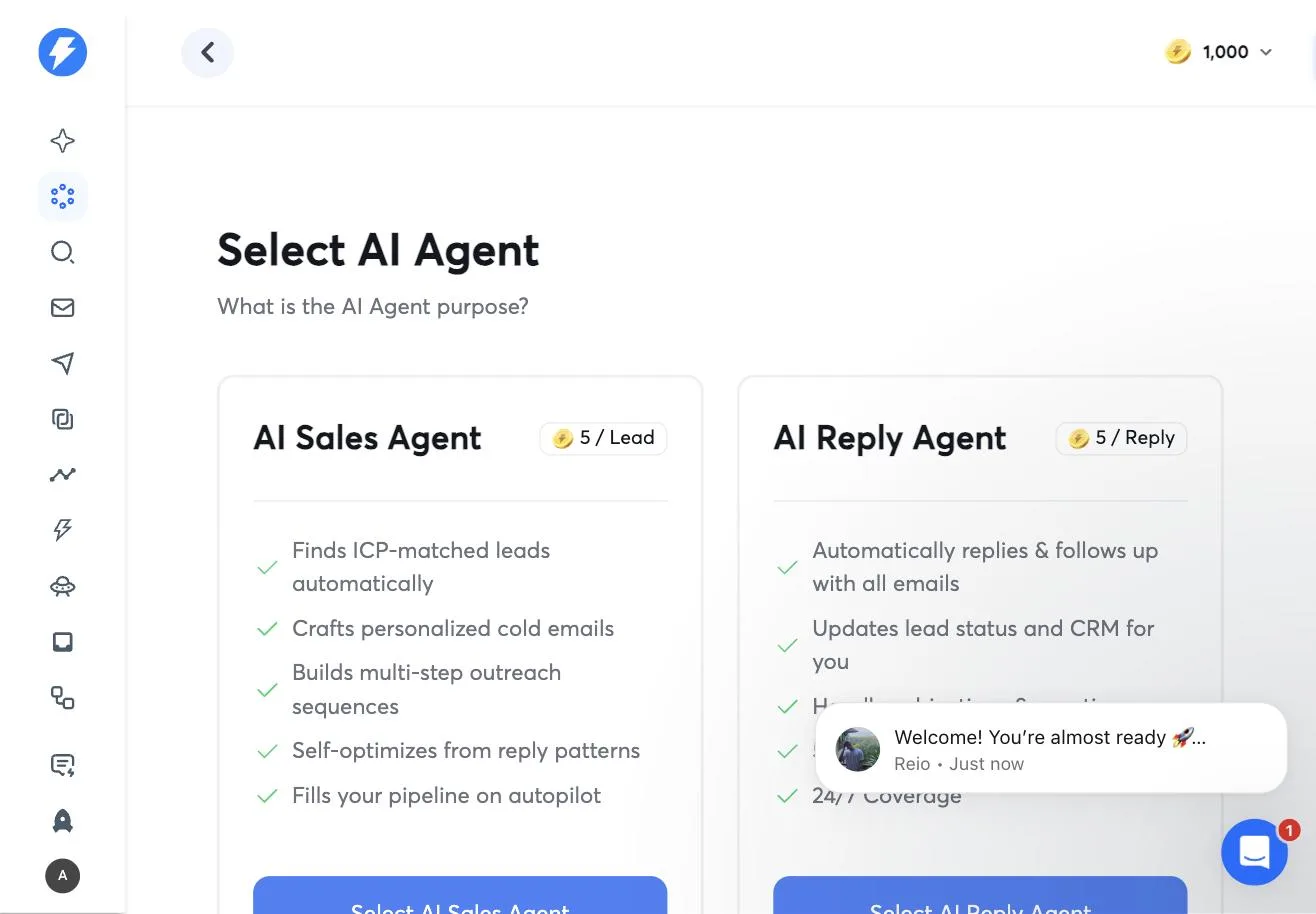
One number to anchor the cost math: a fresh workspace starts with 1,000 free credits. At 5 credits per lead, the AI Sales Agent burns that allowance on 200 leads. The Lead Finder wizard, notably, displays no credit price anywhere in its four setup steps. You find out what a top-up cost after the leads land in your campaign. We flagged the same pattern in our lemlist signal-agents test: agent pricing across this market is consistently disclosed after the fact, not before.
Setup is impressive. Sixty seconds, zero questions.
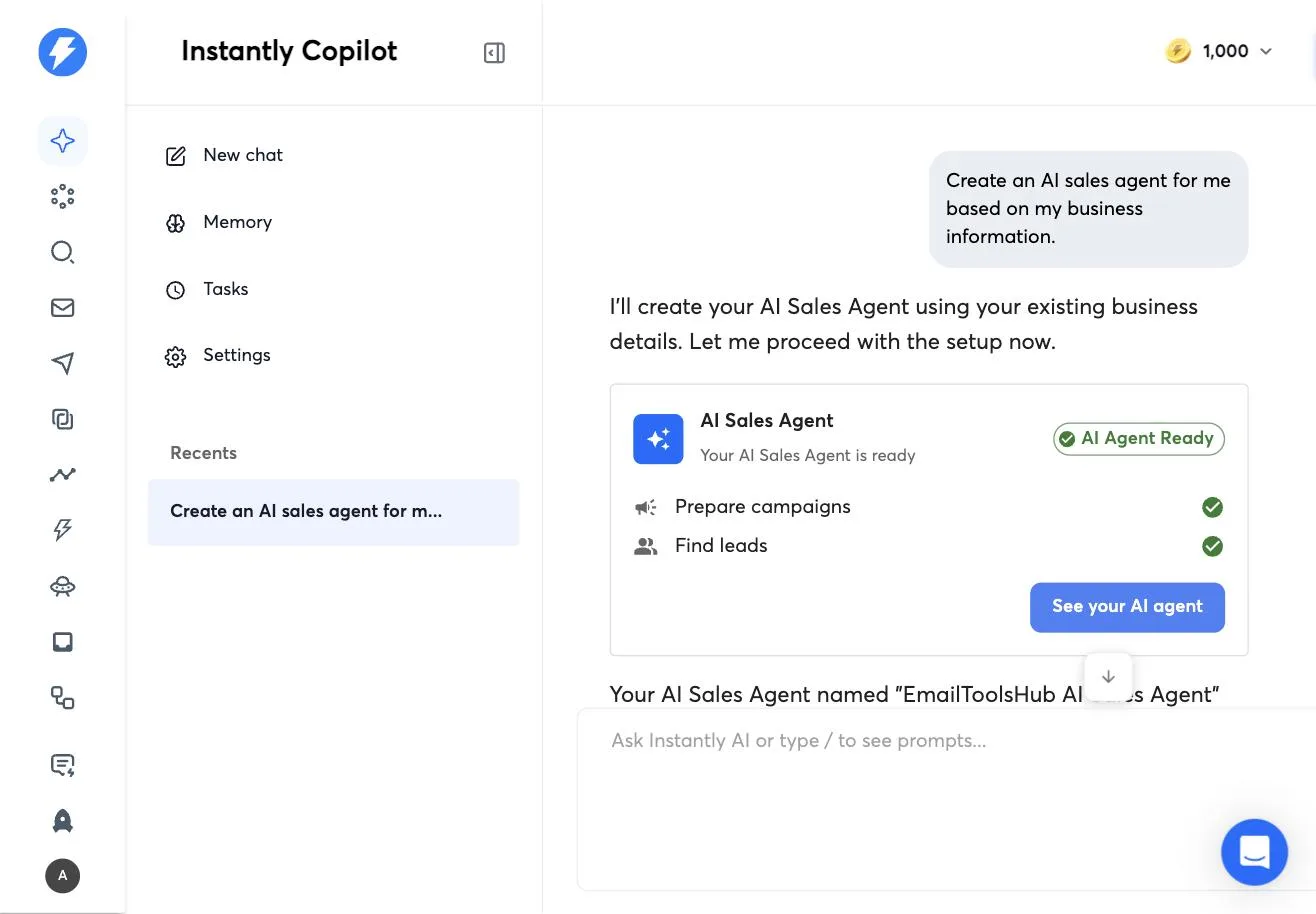
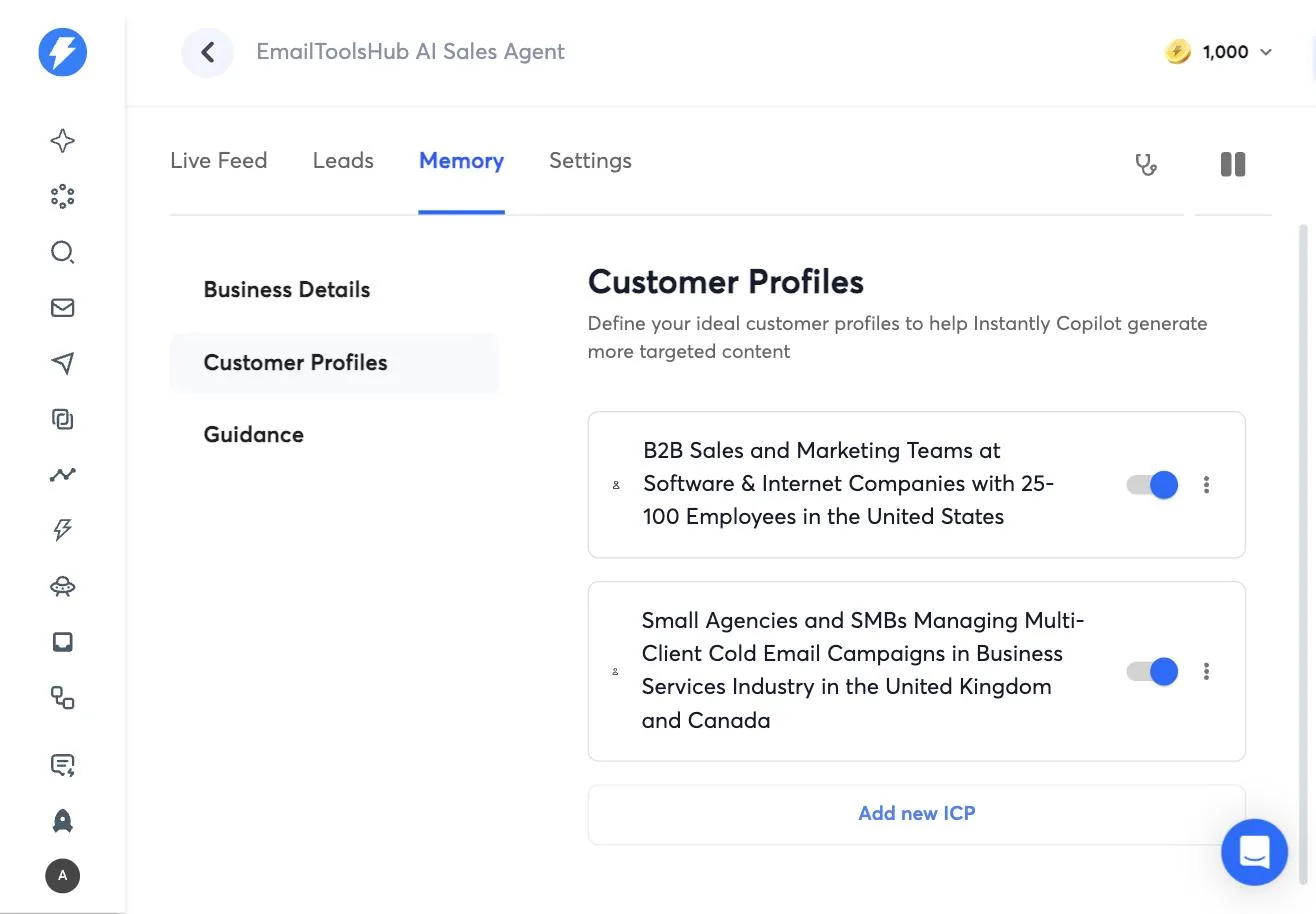
The onboarding flow asks for your website URL and nothing else. From that single input, Instantly generated our company description, two usable customer profiles ("B2B sales and marketing teams at software companies with 25-100 employees in the US" and "small agencies managing multi-client cold email in the UK and Canada"), a fully personalized campaign, and an active AI Sales Agent. Under a minute, no targeting questions asked. The auto-generated business summary was accurate enough that we kept it unedited, which surprised us.
"Activated" does not mean operational
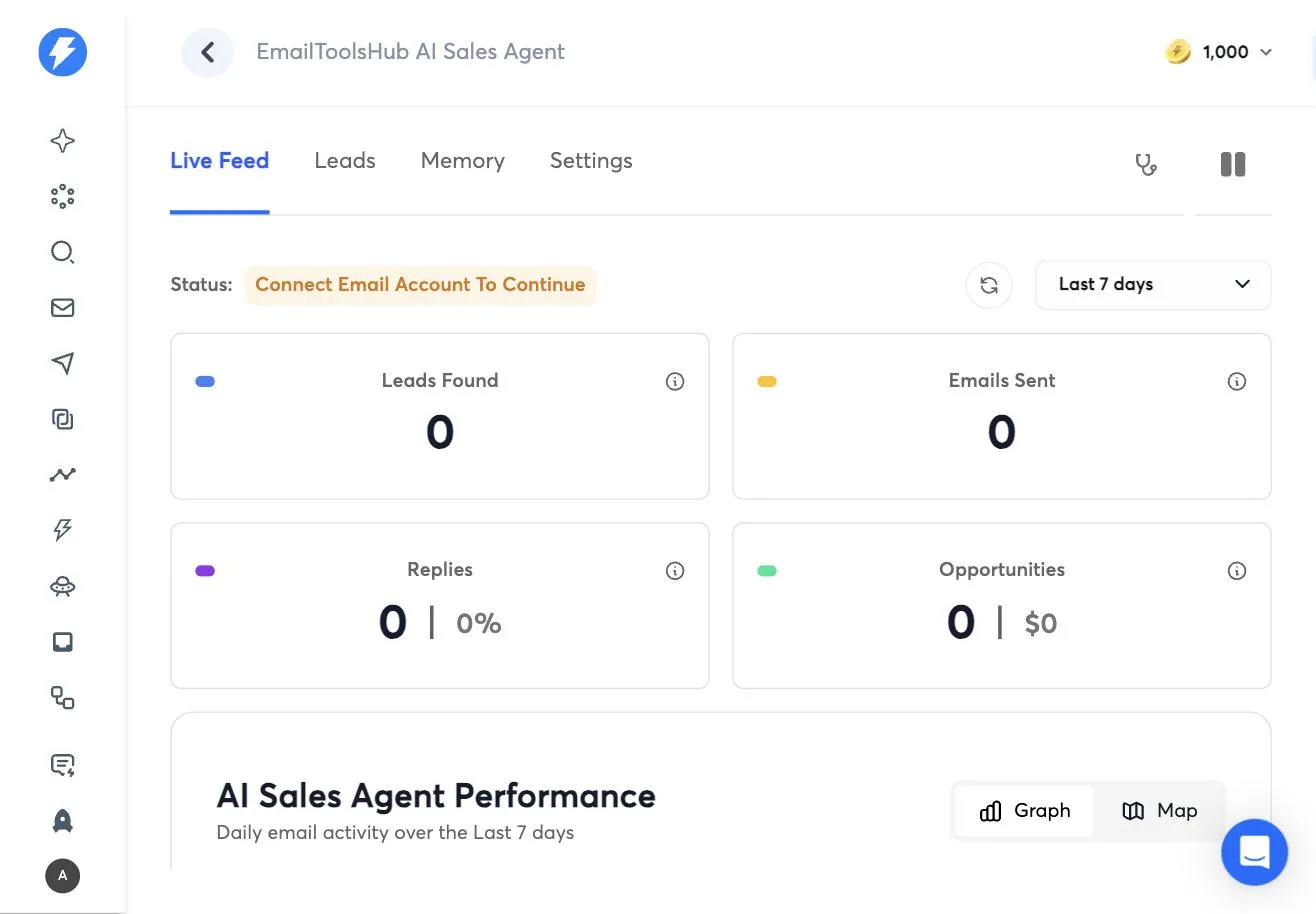
Here is the part the launch material skips. Our agent reported itself "successfully created and activated" and "ready to autonomously handle outbound prospecting." Its actual state: zero leads found, zero emails prepared, and a persistent banner reading "Connect Email Account To Continue." The entire agent stack idles until a sending mailbox is connected. That gate is sensible engineering, an agent with nothing to send from should not run, but the interface announces autonomy it has not earned yet. Budget for the same reality we documented in the deliverability section: mailboxes plus warmup time come before any agent does anything.
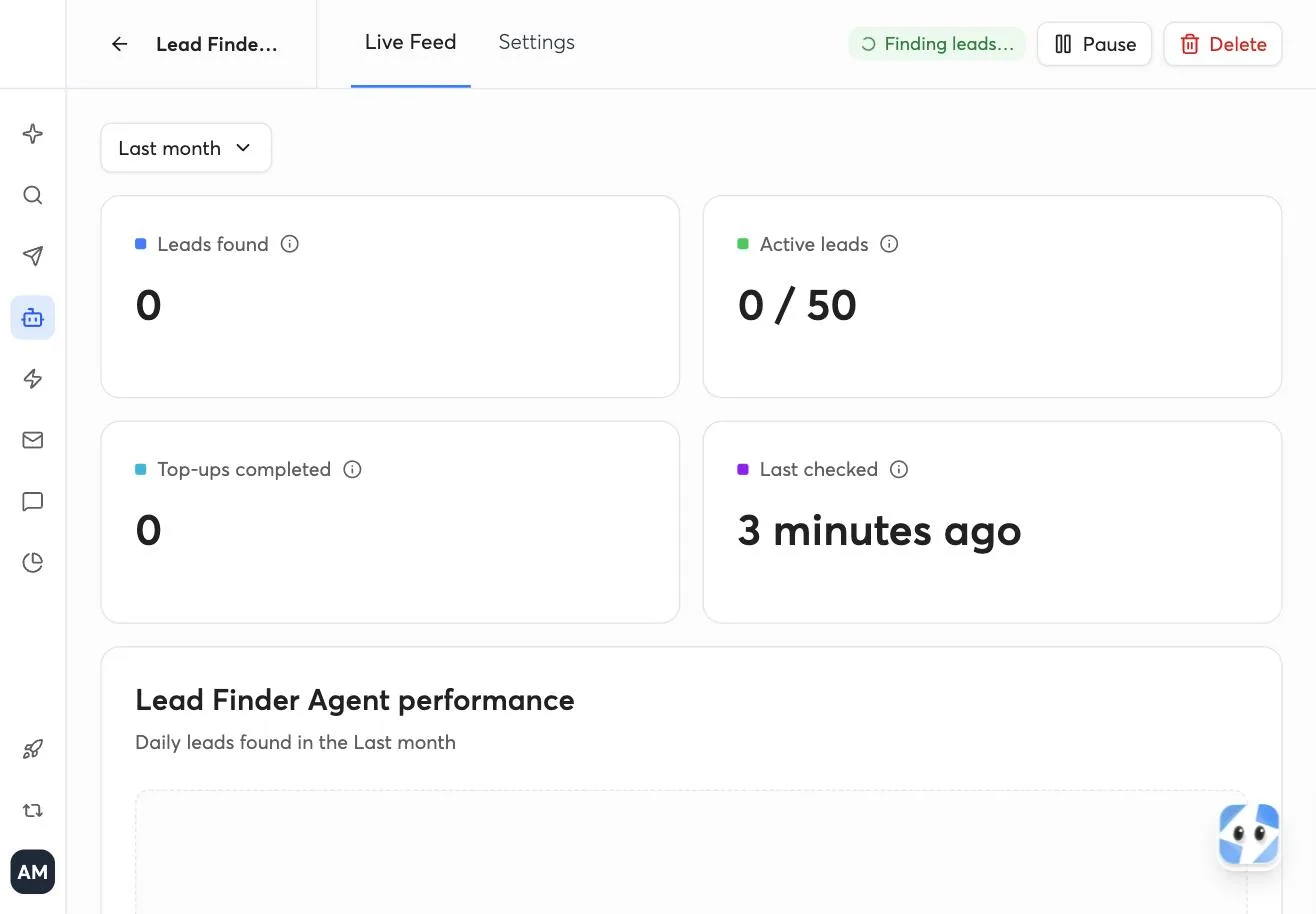
We also ran the clock on the Lead Finder Agent: deployed against the auto-created campaign, it sat at "Looking for new leads" with 0 of 50 delivered ten minutes in, on a workspace with no connected mailbox. Not a failure exactly. But if you expected "attach it and the pipeline refills," expect the mailbox prerequisite first.
The Lead Finder Agent, step by step
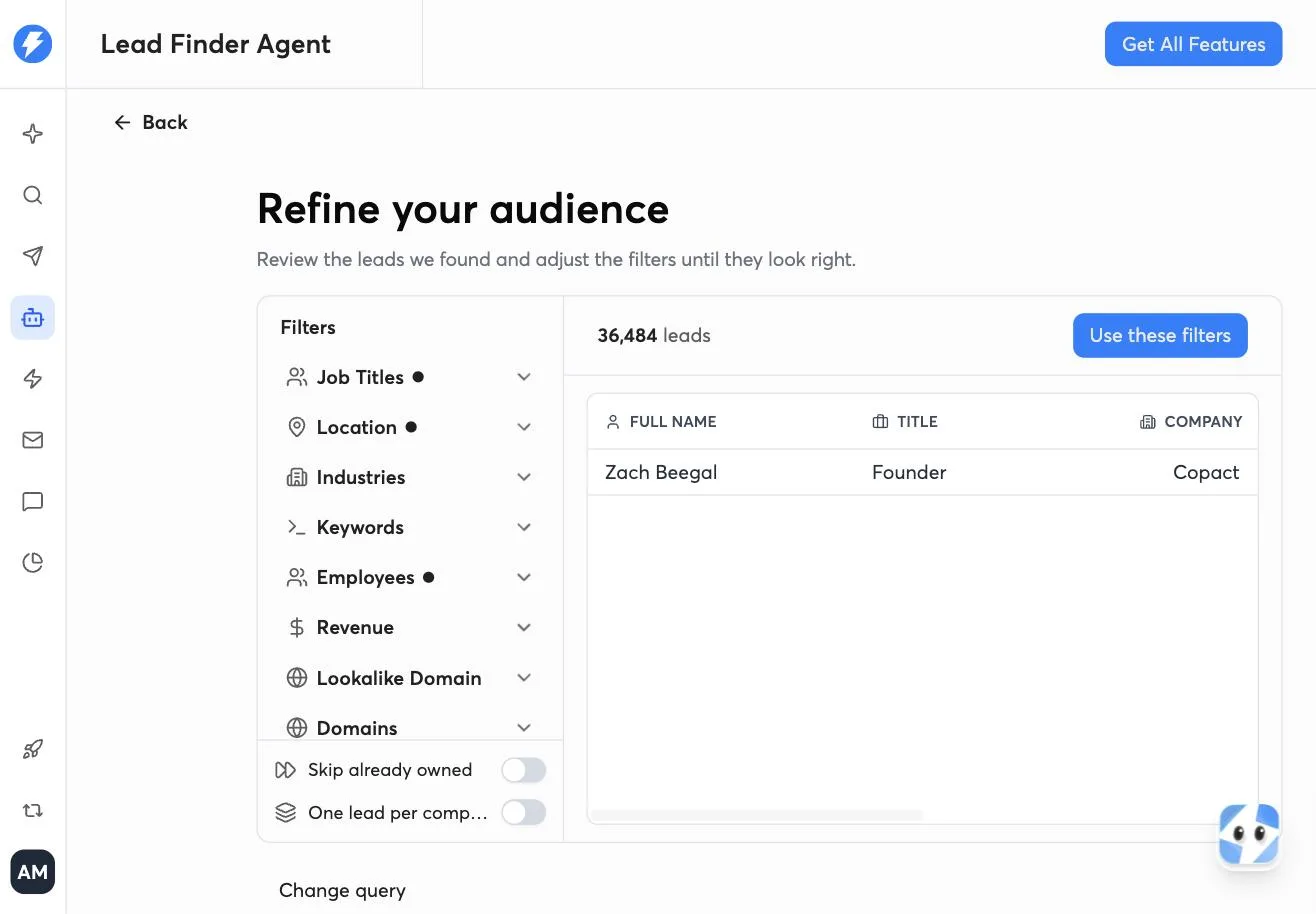
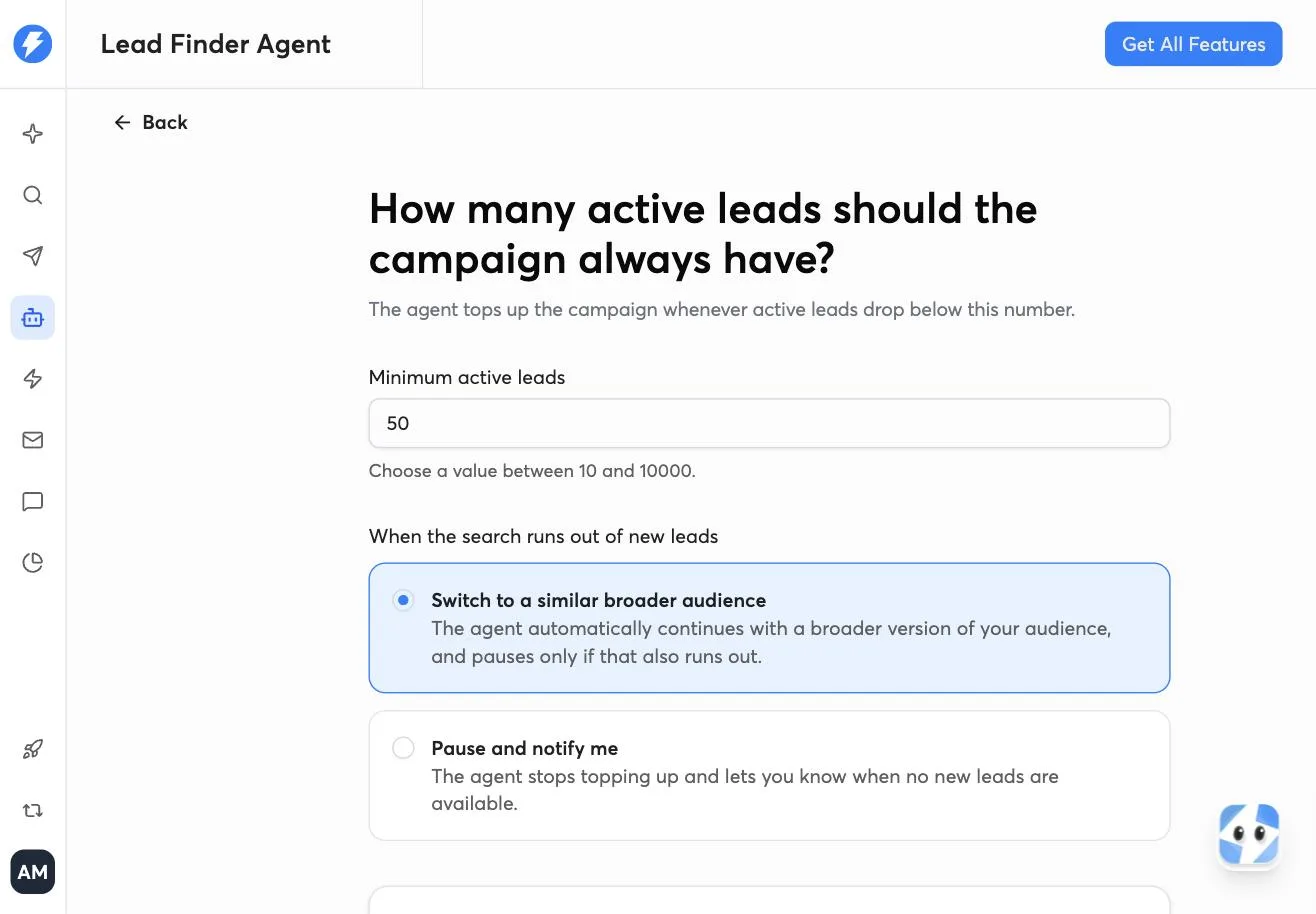
The setup has four steps. Pick a target campaign, mandatory and permanent: the agent cannot run standalone, and the settings page states the campaign "cannot be changed" after creation. Describe your audience in plain language; we typed "founders and heads of growth at B2B SaaS companies with 10 to 100 employees in the United States" and the parser converted it into job-title, location, and headcount filters against a pool it counted at 36,484 matching leads. Set the refill threshold: minimum active leads defaults to 50, range 10 to 10,000. Name it and go.
Three defaults to change before you trust it
The defaults are tuned for volume, not precision, and they deserve a pass before launch. First and most consequential: when the search runs out of new leads, the pre-selected behavior is "switch to a similar broader audience." The agent widens your targeting on its own and pauses only when the broadened search also runs dry. "Pause and notify me" exists, one radio button away, and for most operators it is the right choice: an agent that silently redefines your ICP is how a tight campaign drifts into spray territory. Second: "skip already owned" and "one lead per company" both ship toggled off in the audience filters, so reruns can re-import contacts you already hold and stack multiple people from the same company into one cold sequence. Third: the AI Sales Agent's default sending schedule is midnight to 11:59 PM, every day. A 24/7 sending window is a spam-filter tell; cut it to business hours in the recipient's timezone before connecting anything real. Credit where due: Autopilot mode ships off, human-in-the-loop is the default, and the default daily cap is a cautious 10 emails.
Where this leaves Instantly against lemlist
Our July 22 position was that lemlist ran ahead on AI while Instantly shipped nothing equivalent. That gap narrowed in one day. Instantly now fields a real agent stack, and its from-one-URL setup is smoother than anything in lemlist's AI Context Center. Two differences persist. lemlist's signal agents act on buying signals (job changes, fundraising, hiring) while Instantly's agents act on ICP filters, a meaningful difference in lead quality logic. And lemlist ships a first-party MCP that connects the tool to Claude and ChatGPT; Instantly still has no equivalent as of July 23, 2026. Full comparison in the lemlist review and on our statistics page.
Copilot, for completeness
The older AI surfaces remain: campaign-copy generation for subject lines, openers, and sequence drafts, plus lead enrichment in the contact module. Competent first drafts. Edit before sending.
Real-world performance, in their own words
Most reviewer sites don't publish reply-rate or volume numbers because vendors don't share them. Instantly is one of the few that publishes specific case studies tied to its own product. Two are worth reading before deciding whether the tool fits your operation.
The first documents an agency scaling to 10,000 daily emails across multi-inbox rotation and multiple sending domains. It breaks down per-inbox volume ramp, warmup activation behavior, and how the agency staged the migration. Useful if you're running outbound for several client domains and need to understand how the platform handles concurrent sending. Full breakdown is on Instantly's blog: Scaling to 10,000 daily emails (Instantly blog).
The second documents a structured cold email sequence that produced a 20% meeting booking rate. The framework covers sequence design, timing, and the personalization logic that drove the rate. Useful as a reference point if you're building a meeting-booking sequence from scratch. Full framework is here: 20% meeting booking rate framework (Instantly blog).
Both are vendor-published case studies, attributed accordingly. We're sharing them because they contain concrete numbers most reviews skip, not because we ran the campaigns ourselves.
Main features in detail
Campaign management
The sequence builder supports time-spaced steps, conditional logic on replies and clicks, A/B variants on subject and body, and per-step throttling. Schedule sending by timezone, by day, and by working hours. Standard merge fields plus custom variables that you can import from CSV.
Unlimited inbox positioning
The single feature that differentiates Instantly's pricing at scale is that every paid plan includes unlimited connected inboxes. Most competitors price per inbox, which makes Instantly significantly cheaper once you cross five to ten sending mailboxes. For agencies, this is often the deciding factor.
Warmup
Built-in warmup uses Instantly's network of inboxes to simulate human conversation activity: opens, replies, archiving, and marking as important, so your sending reputation builds gradually. Volume ramp is configurable per inbox, and reply rate and weekday-only settings affect how the warmup blends in.
Analytics
Beyond the dashboard, Instantly exposes per-campaign exports, per-inbox metrics, and webhook events. You can pipe data into Slack for live reply notifications or into a spreadsheet for custom reporting.
CRM / opportunities
A lightweight pipeline with stages, deal value, and notes. Suitable for solo operators and small teams, though not a HubSpot replacement at the enterprise level.
AI assistance
Embedded AI for copy drafting, subject-line variants, and persona-based personalization. Treat it as a junior copywriter that hands you a first draft.
Lead management
Native lead lists with filters, deduplication, and bounce or blacklist tracking. Bulk imports from CSV, with integrations to most major data sources available through Zapier and the Instantly API. For upstream finding and verification before pushing leads into Instantly, the standard pairing is a dedicated finder plus verifier. See our Snov.io review for the most common budget-friendly choice.
Integrations and API
Instantly connects to the rest of an outbound stack through a public API, webhooks, and Zapier. The common patterns operators set up are a finder or verifier feeding lists in (Hunter, Snov.io, Apollo, or Findymail), reply and opportunity events firing out to Slack or a CRM, and campaign data exported to a spreadsheet for custom reporting. If your workflow depends on a tight two-way sync with a specific CRM, check that integration before committing, since the native CRM is deliberately lightweight and most teams keep their system of record elsewhere. The practical setup most operators land on is simple: a finder upstream of Instantly, a verifier between the two, Instantly in the middle for sending and rotation, and a CRM or spreadsheet downstream catching replies through a webhook. Wire those four connections once and the daily workflow runs without you touching the plumbing again.
Instantly vs lemlist vs Apollo
Most operators evaluating Instantly are also looking at lemlist and Apollo. They serve different parts of the same outreach workflow:
- Instantly wins on scale and inbox rotation. If you're sending more than 500 cold emails per day across multiple domains, Instantly's pricing model and warmup network are the structural advantages.
- lemlist wins on personalization. Dynamic image personalization, Liquid templating, and account-based-style sequences are where lemlist invests. It's the tool to pick if each deal is worth thousands and reply rate matters more than send volume.
- Apollo wins on database plus all-in-one prospecting. The 275M-contact database is the deepest in this category, and the sender is good, though not as deliverability-focused as Instantly. The all-in-one pricing makes sense for solo founders who don't want to manage multiple tools.
| Criterion | Instantly | lemlist | Apollo |
|---|---|---|---|
| Starting price | $37/mo | $39/mo | $49/mo (free plan available) |
| Free trial | 14 days | 14 days | Free forever (limited) |
| Email accounts (paid) | Unlimited | Per-seat pricing | 5 to 25 by tier |
| Native warmup | Built-in network | lemwarm | Basic |
| Contact database | Higher plans | No | Large native database |
| Personalization | Liquid + AI | Liquid + AI + dynamic images | Merge tags + AI |
| Deliverability focus | Strong | Strong | Moderate |
| Best for | Scale + inbox rotation | Personalized outreach | Data + sending together |
For a full side-by-side breakdown including pricing scenarios at scale, see our Instantly vs lemlist vs Apollo comparison.
Taken two at a time, the comparisons that decide things are Instantly vs Apollo, a sender set against a database rather than a like-for-like fight, and lemlist vs Instantly, where per-seat personalization runs against per-inbox volume. For the closest matchup of all, see Instantly vs Smartlead.
One gap worth naming while comparing agent stacks: Instantly ships no first-party MCP. lemlist does, and it is the clearest practical difference between the two right now for anyone running their outbound from a chat window. The setup and its limits are on our lemlist MCP with Claude page.
Pros and cons
Pros
- Unlimited inboxes on every paid plan, the structural advantage at scale
- Built-in warmup network removes the need for a separate warmup tool
- Clean multi-inbox rotation across many sending domains
- Operator-focused dashboards: per-inbox health, per-campaign analytics, per-account warmup
- Reasonable entry-level pricing with a meaningful free trial
- Active product development, with new features shipping regularly
Cons
- Overkill for solo operators with a single inbox and low send volume
- Personalization features are good, but not as deep as lemlist's image and templating system
- The built-in CRM is lightweight, so serious pipeline management means integrating an external CRM
- UI density can feel busy when you're running many simultaneous campaigns
Common mistakes operators make with Instantly
Instantly removes a lot of operational risk, but it can't stop you from making the mistakes that happen upstream of the tool. The patterns that show up most often:
- Sending before warmup finishes. The software lets you launch a campaign on day one. Deliverability doesn't. A new inbox needs roughly two to four weeks of warmup before real cold volume, and skipping that is the fastest way to land in spam regardless of the tool.
- Skipping authentication. The onboarding wizard flags missing SPF, DKIM, or DMARC, but it's easy to click past the warning. Launching on an unauthenticated domain undoes everything else the platform does for you.
- Pushing volume through too few inboxes. The whole point of unlimited inboxes is to spread volume. Loading 500 daily sends onto two mailboxes defeats the rotation model and looks unnatural to filters.
- Feeding it an unverified list. Instantly sends what you give it. A scraped or stale list produces a bounce rate that damages every domain in the rotation. Run lists through a verifier first.
- Treating native enrichment as a finder. The lead database is a convenience, not a replacement for a dedicated finder. For coverage and accuracy, pair Instantly with Hunter or Snov.io upstream.
TL;DR
- Our score: 9.4/10
- Pricing sweet spot: Growth at ~$37/mo for unlimited inboxes; Hypergrowth ~$97/mo once you need the lead database and higher sending
- Best for: Lead-gen agencies, founders sending 500+ emails/day, and multi-domain operators
- Skip if: You're solo with one inbox, or you need deep 1:1 personalization (lemlist is stronger there)
- Signup gotcha: The trial verifies a real company website, so solo founders with only a LinkedIn profile can get blocked
- Alternative if blocked: Snov.io (freemium, no domain check) or Smartlead (~$39/mo)
Bottom line
For B2B operators, agencies, and small sales teams scaling cold email past one or two inboxes, Instantly is the most defensible default in 2026. The unlimited-inbox pricing and bundled warmup mean it both saves money at scale and removes operational steps. The product is opinionated, but its opinions match the workflow of operators who treat cold email seriously rather than as a side experiment.
If you fit one of the personas in the "best for" section above, the free trial is worth the hour it takes to set up. If you fit the "skip" section, lemlist or Apollo are likely a better starting point.
Frequently asked questions
Is Instantly good for beginners?
Yes, with one nuance. The onboarding flow is well-designed and the documentation is solid, so a beginner can get a campaign running in an afternoon. The nuance is that Instantly's value is most obvious at scale. A beginner sending 30 emails per day from one inbox won't feel the structural advantages over a simpler tool until they grow. If you're confident your motion will scale, start with Instantly. If you're experimenting, any of the major tools will do.
Does Instantly include warmup?
Yes. The warmup network is bundled in every paid plan and configurable per inbox. You don't need a separate warmup tool like Warmup Inbox or MailReach when using Instantly. See our broader guide to email warmup tools for context on how warmup works.
How much does Instantly cost?
At the time of writing, the entry Growth plan starts around $37 per month with unlimited connected inboxes and bundled warmup. Hypergrowth is around $97 per month and adds a larger contact allowance, higher monthly sending, and lead database access. Light Speed sits around $358 per month for high-volume teams and adds a dedicated customer success manager. Plans and prices change, so verify the current numbers on Instantly's official pricing page before subscribing.
Do I need a separate sending domain?
Strongly recommended. Sending cold email from your main company domain risks your transactional and marketing email reputation if anything goes wrong, such as bounces, spam complaints, or blacklists. The standard pattern is to buy a separate domain, something like getyourcompany.com or yourcompany.io, and use it exclusively for cold outbound. Most operators run two to ten separate sending domains for redundancy.
Can I use Instantly with Gmail or Outlook?
Yes. Instantly connects to Google Workspace, Microsoft 365, and any custom SMTP or IMAP provider. Free Gmail accounts aren't suitable for cold email regardless of the tool you use. You need a paid Google Workspace or Microsoft 365 mailbox tied to your sending domain.
Is Instantly better than lemlist?
For high-volume sending across multiple inboxes, yes. Instantly is built for that motion. For deals where personalization is the deciding factor and each conversation is worth thousands of dollars, lemlist's image personalization and Liquid templating give it the edge. Most teams pick one based on which problem they want to optimize for. See our Instantly vs lemlist vs Apollo comparison for the side-by-side.
Is Instantly better than Apollo?
It depends on what bottlenecks you. Instantly is a sharper cold email sender. Apollo is a database plus sender combo. If your bottleneck is sending deliverability at scale, Instantly is better. If your bottleneck is finding contacts in the first place and you'd rather pay one bill, Apollo is better. Many operators run both, Apollo for prospecting and Instantly for sending.
How long does it take to set up Instantly before sending?
The software setup takes an afternoon: connect inboxes, verify authentication, and build a sequence. The real timeline is deliverability, not software. A brand new sending domain and inbox needs roughly 14 to 28 days of warmup before you send real cold volume. Instantly automates that warmup, but the calendar time still applies, so plan to set up the account two to four weeks before your first campaign needs to go out.
Should I use my main company domain for cold email?
No. Cold email, even when done carefully, can cause spam complaints, bounces, or temporary blacklists. If those events happen on your main domain, your transactional email such as password resets, invoices, and support, plus your marketing email reputation, suffer at the same time. Buy a dedicated sending domain, warm it up properly, and isolate the risk.
Is Instantly worth it in 2026?
For teams sending 500+ cold emails per day across five or more inboxes, yes. The unlimited-inbox pricing beats every per-seat alternative once you're at that scale, and the bundled warmup removes a separate subscription. For a solo operator sending under 100 emails a day from one inbox, the value is less obvious, and Smartlead at around $39/mo or Snov.io on freemium delivers similar results at a lower or zero cost. The verdict tracks your volume trajectory more than your budget.
Does Instantly work without a company website?
Often no. Instantly's signup verifies that your company website is real and business-like, so solo founders with only a LinkedIn profile, freelancers testing before recommending to clients, and SDRs evaluating internally sometimes get blocked. If that describes you, start with Hunter (free tier, no domain check) or Snov.io (freemium, optional company field), then move to Instantly later once your operation has a formal footprint. It's the single most common reason people bounce off the signup.
What's included in Instantly's free trial?
The trial gives access to the core sending features, unlimited inboxes, bundled warmup, and the campaign engine, with a limited contact allowance, and it converts to paid automatically unless you cancel. Realistically most operators need two to three weeks to evaluate a cold email tool properly, since warmup alone eats the first couple of weeks, so treat the trial as a shorter window than ideal and plan the evaluation before you start the clock.
What is Instantly's Lead Agent and what does it cost?
Lead Agent, listed in the product as Lead Finder Agent, launched July 22, 2026. It attaches to one campaign, watches the active-lead count, and refills it automatically whenever the count drops below your threshold (default 50, range 10 to 10,000). Free to deploy on every plan; credits are consumed per lead found. In our hands-on test the wizard showed no credit price at any of its four steps, so anchor your budget on the balance instead: fresh workspaces get 1,000 free credits, the AI Sales Agent prices at 5 credits per lead, and the AI Reply Agent at 5 credits per reply. The full test with screenshots is above.
Do Instantly's AI agents work without a connected email account?
No. In our test the AI Sales Agent called itself "activated" within a minute, then found zero leads behind a "Connect Email Account To Continue" banner, and the Lead Finder Agent idled at "Looking for new leads" on the same workspace. Every agent waits for a connected sending mailbox, and a new mailbox still needs its 14 to 28 days of warmup, so sequence the mailbox and warmup timeline before counting on the agents for pipeline.
Next steps
If Instantly fits your situation, start with the free trial and run a small warmed-up sequence before committing to a paid plan. To put Instantly in context, see our broader cold email tool guide, the head-to-head with lemlist and Apollo, and the email finder comparison for picking the right list-building tool to feed your campaigns. For how we review tools, see our methodology.

About the author
Marwene Amor · Founder @ EmailToolsHub
I review B2B cold email tools as an independent operator, testing the products myself and writing the honest version of what I find. More about me or connect on LinkedIn.
Related Reviews & Guides
Other deep dives on EmailToolsHub that pair well with this one.
Best Email Warmup Tools 2026
Instantly has built-in warmup. Here's how it compares to dedicated tools.
Read it →Cold Email Deliverability Checklist
The pre-flight checklist before your first Instantly campaign.
Read it →