Hunter.io Review 2026: Still the Cleanest Email Finder, and No Longer Just a Finder
· 19 min read · By Marwene Amor
Quick answer: Hunter is still the cleanest email finder and verifier in 2026, and it is quietly no longer just a finder. The free plan now gives 50 credits a month, paid tiers start at $49/mo ($34/mo billed annually), and the product has grown a real sending layer: Sequences with A/B testing, managed email accounts with warmup, and progressive sending. It also ships the deepest MCP integration in the category, 100 tools your AI assistant can call directly, which we tested hands-on on July 28, 2026. Best for operators who want accurate finding and verifying with honest confidence scores, whether they feed an existing sender or run light sequences inside Hunter. Apollo still wins on raw database discovery, and Snov.io still wins on bundle price. Signup takes one email with no company website required, so solo founders can start immediately.
- The full feature set: Domain Search, Email Finder, the verifier, Discover, bulk tasks, the Chrome extension, Sequences, and the API.
- The MCP server, tested call by call: 100 tools, what each costs in credits, and the guardrails Hunter built for AI agents.
- What Hunter shipped from mid-2025 through 2026: unified credits, managed inboxes, warmup, A/B testing, Discover AI search.
- A per-plan pricing breakdown (Free, Starter, Growth, Scale) plus pricing by use case.
- A Hunter vs Snov.io vs Apollo comparison, data accuracy, the LinkedIn workflow, and a compliance note.
- An FAQ with structured data, and where Hunter fits in a full outbound stack.
Most cold email stacks have one tool that quietly does the unglamorous job of turning a name and a company into a real, deliverable email address. For a large share of B2B operators, that tool is Hunter. It has been the default dedicated email finder for years, and its pitch is simple: do one thing, finding and verifying B2B emails, and do it cleaner than the all-in-one platforms that bolt finding onto a dozen other features.
Except that pitch is a year out of date, and almost nobody covering Hunter has noticed. Between mid-2025 and mid-2026, Hunter unified its metering into one credit system, added an AI writing assistant, shipped a natural-language layer on its Discover database, started provisioning managed sending inboxes with automated warmup, added A/B testing to sequences, and released the deepest MCP server in the cold email category. We retested the product hands-on on July 28, 2026, both in the web app and through that MCP server, and this review reflects what Hunter actually is now, not what it was when the "just a finder" framing was accurate.
Quick verdict: Hunter is the cleanest email finder and verifier in 2026, and its finding accuracy remains the reason to buy. What changed is the rest: Sequences, managed inboxes with warmup, and a 100-tool MCP server make it a credible light outreach platform, not just the front end of one. It's the right buy if accurate finding and verifying is the core job. If you want the cheapest possible bundle, Snov.io still undercuts it. If your real bottleneck is a large prospect database, Apollo wins.
Hunter at a glance
| Attribute | Detail |
|---|---|
| Best for | Operators who want accurate, auditable finding and verifying, with a light sending layer when they need one |
| Starting price | Free tier (50 credits/mo), then $49/mo, or $34/mo billed annually (Starter) |
| Database size | 100M+ verified email records |
| Standout feature | Confidence scores with public sources on every result, plus a 100-tool MCP server for AI assistants |
| Weak spot | Email account caps per plan keep it below Instantly for volume sending; thinner on enterprise C-suite data than RocketReach |
| Our take | The finder to beat, now with enough sending machinery to carry a solo operator's first campaigns |
Who Hunter is best for
Hunter's whole product is built around focus. That makes it an obvious fit for some operators and the wrong tool for others. It fits best for these four groups:
- Operators who already have a sender. If you run Instantly, lemlist, Smartlead, or Apollo for sending, Hunter is the clean upstream finder that feeds verified addresses into it without overlap.
- Teams that value a short learning curve. Hunter does one job, so the interface is fast and almost self-explanatory. New team members are productive in minutes, not hours.
- SMB and mid-market prospectors. Hunter's data is strongest on common B2B domains, which is exactly where most small and mid-market outreach lands.
- Anyone who wants confidence scores they can trust. Every result comes with a score and supporting sources, so you can judge quality before an address ever enters a campaign.
Who should skip Hunter
Hunter's focus is also its limit. Look elsewhere if any of these describe you:
- You want one tool for finding and sending. Hunter's Campaigns feature is light. If you want the finder and the sender in one subscription on a budget, Snov.io bundles both more completely.
- Your bottleneck is the prospect list itself. If you need to discover net-new accounts at scale, Apollo's 275M-contact database is a different class of tool. Hunter assumes you already know who you want to reach.
- You target enterprise C-suite with phone numbers. RocketReach and Cognism go deeper on executive direct dials. Hunter is email-first.
- You need a high-volume sender. Hunter's sending layer got serious in 2026 (Sequences, managed inboxes, warmup, progressive sending), but email accounts are capped per plan: 1 on Free, 3 on Starter, 10 on Growth, 20 on Scale. For agency-scale volume across dozens of rotating inboxes, Instantly's unlimited-inbox model is still the right machine.
What Hunter actually is
Hunter is an email finder and verifier that has been quietly rebuilding itself into an outreach platform. The core is unchanged: you give it a domain or a name plus a domain, and it returns the most likely professional email address, with a confidence score and the public sources that back it up. Around that core sit the verifier, a bulk processor, the Discover company database with natural-language search, a Chrome extension, a public API, and, since 2026, a sending layer that no longer deserves the word "lightweight": Sequences with step-level A/B testing, managed email accounts Hunter provisions for you with SPF, DKIM, and DMARC configured, automated warmup, and progressive volume ramp-up.
The discipline that made Hunter good is still visible: every piece stays close to the data, every result stays auditable, and nothing is bolted on for the feature list's sake. But the buying logic has changed. In 2025 you bought Hunter to feed another tool. In 2026 a solo operator can run the whole early motion inside it: find, verify, sequence, send, and only graduate to a dedicated volume sender when inbox count becomes the constraint. If you want fewer subscriptions and the cheapest bundle, Snov.io still exists. If your bottleneck is discovering who to target at scale, Apollo's database is the different class of tool. Knowing which camp you're in makes the decision easy.
What Hunter shipped from mid-2025 through 2026 (the part most reviews missed)
Hunter does not make noise when it ships, so the scale of the last twelve months is easy to miss. Here is the timeline, from Hunter's own changelog, that turned a finder into a platform. Each of these is live in the product today; we confirmed the ones that matter most during our July 28 session.
- July 2025: unified credits. The old searches-and-verifications split became one credit system across every finding and verification tool, with manual credit packs (3-month validity) and free monthly re-verification of saved leads. One number to watch instead of two.
- July 2025: the MCP server. Hunter released a first-party MCP integration, then moved it to a hosted remote server. This is the piece we tested in depth below, and it has grown into something no competitor matches.
- August 2025: AI Writing Assistant in the sequence editor, for generating personalized cold emails at scale.
- October 2025: LinkedIn handles in the Email Finder. The finder and the API now accept a LinkedIn handle instead of a name, which quietly fixes the messiest part of the Sales Navigator workflow. New Enrichment and Discover API endpoints shipped the same month.
- November 2025: reply intelligence. Sequences now auto-detect unsubscribe requests and out-of-office replies and handle them without you.
- January 2026: transparent sources. Every email record now labels where it came from, with source URLs and first-seen and last-seen dates visible.
- February 2026: partial reveals. If a Discover dataset needs more credits than you have, Hunter reveals what your remaining credits cover instead of refusing the whole job. Small thing, exactly right for free and low-tier plans.
- March 2026: the sending push. Step-level A/B testing in Sequences with automatic winner selection. Natural-language search in Discover ("sales managers at SaaS companies in Germany" becomes configured filters). Progressive Sending, which ramps daily volume on new accounts based on bounce health. And an Email Accounts Center with a global health score across authentication, reputation, and activity.
- April 2026: managed email accounts. Hunter now sells domains and provisions sending inboxes directly, ready in about an hour with SPF, DKIM, and DMARC configured, plus Inbox Protection, an automated 30-day warmup that builds sender reputation before real volume.
- June 2026: recipient-based engagement stats in Sequences, which is the honest way to count (more on why open-rate math lies in our statistics page).
Read that list twice and the pattern is obvious. The finder that told everyone to pair it with a real sender spent a year building the sender. It has not matched Instantly's rotation depth, and the per-plan inbox caps say Hunter knows that. But the "Hunter can't send" line that every comparison article still repeats, ours included until this update, stopped being true somewhere around March 2026.
Tested hands-on: Hunter's MCP server (July 28, 2026)
This is the section almost nobody in the category has written, so we went deep. MCP (Model Context Protocol) is the standard that lets AI assistants like Claude and ChatGPT call a product's tools directly from a conversation. lemlist ships one (10 consolidated tools in the Claude directory, 34 on its wizard route) and we covered it first. Instantly and Smartlead ship none as of July 2026. Hunter's remote MCP server, when we connected to it on July 28, reported version 0.7.0 and exposed exactly 100 tools. That is not a typo, and the number is not padding: the toolset covers the entire product surface.
Setup: one URL, one API key
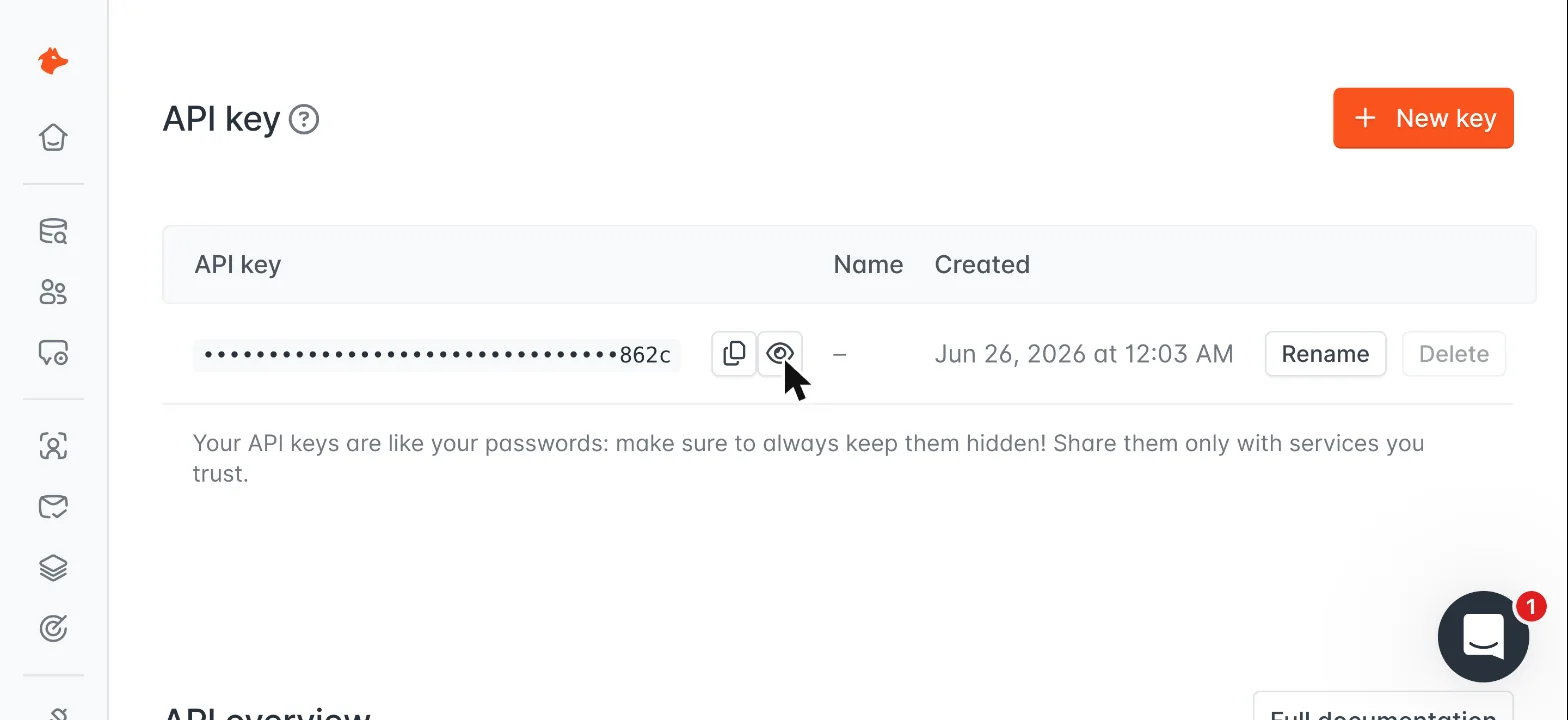
Connection is simpler than lemlist's five-step wizard. The server lives at a single endpoint (mcp.hunter.io/mcp), authenticates with your Hunter API key as a bearer token, and works with any MCP-capable client: Claude, ChatGPT, Gemini, or your own agent stack. There is no OAuth dance and no separate grant flow, which cuts both ways. Setup takes under a minute, but the API key carries your full account authority, so treat it like the password Hunter's own dashboard tells you it is. Your key is on the API keys page, free plan included; API access stopped being a paid-only feature some time ago.
What the 100 tools actually cover
The obvious ones are there: Domain-Search, Email-Finder, Email-Verifier, Email-Count, person, company, and combined enrichment, plus Discover's Find-Companies and Find-People. What surprised us is everything else. The MCP can list, create, update, start, pause, resume, and archive Sequences. It manages leads, lead lists, tags, custom attributes, folders, message templates, saved searches, webhooks, connected apps, and CRM pushes. It can even create and delete API keys. In practice, the full lifecycle of a prospecting motion, from "find me companies like X" to "start the sequence", is drivable from a chat window.
Three details told us someone at Hunter thought hard about agent behavior rather than just wrapping their REST API:
- Guardrails are written into the tools. Delete-Sequence only works on drafts. Start-Sequence, the one tool that triggers real emails to real people, is documented as requiring an explicit user go-ahead. Destructive operations warn that they are permanent.
- A planning tool orchestrates the rest. A meta-tool called Plan-Prospecting-Flow takes a natural-language brief ("find 10 heads of sales at US sales-tech companies, verify their emails, prep a 2-step intro sequence") and returns a structured plan chaining the right tools, with instructions to the AI that include "present the matches and ask the user which to investigate; do not auto-pick the top result" and to save nothing unless the user explicitly asked. That is human-in-the-loop design at the protocol level.
- Cost awareness is built in. Tool descriptions state which calls are free and which consume credits, and a Get-Usage tool reports the live meter so an agent can check before a large credit-consuming run. Free-plan users get the same access, just a smaller meter.
What each call costs: we measured it
Because every MCP call hits the same metering as the web app, we ran the core tools in order and read the meter after each one. Numbers from our live free-plan account, July 28, 2026:
| Call | What it returned | Credit meter |
|---|---|---|
| Get-Usage, Email-Count, Company-Enrichment, Person-Enrichment, Find-Companies (Discover search), list and account tools | Counts, firmographics, person profiles, company matches | Free. Meter did not move. |
| Domain-Search (one page of results) | Named contacts with positions, confidence scores, sources, LinkedIn URLs, and a decision-maker flag | 1.0 credit per page, regardless of how many contacts come back |
| Email-Verifier (one address) | Status, 0-100 score, SMTP checks, full source list | 0.5 credit |
| Email-Finder (one person) | The address, score, sources, LinkedIn URL | 1.2 credits observed: 1 for the find plus embedded verification activity |
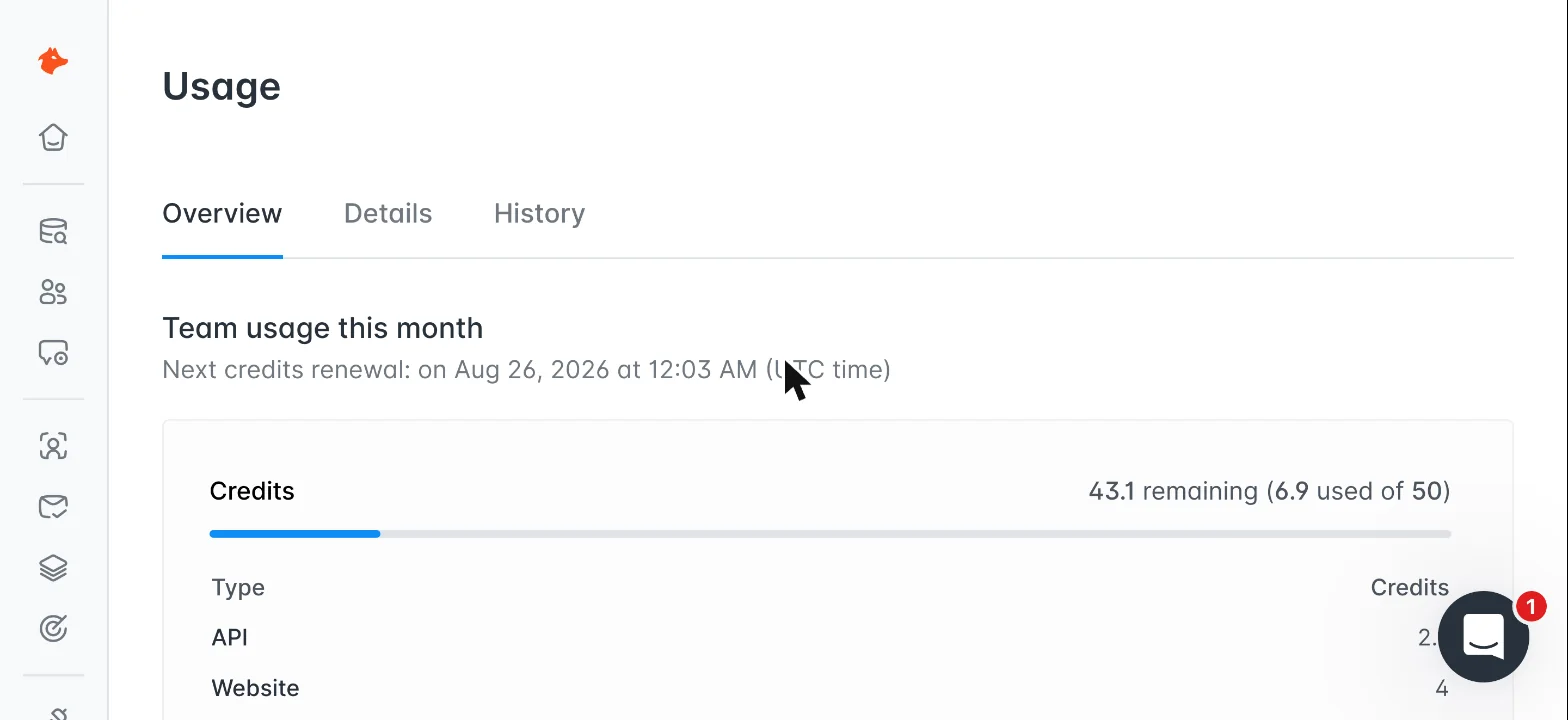
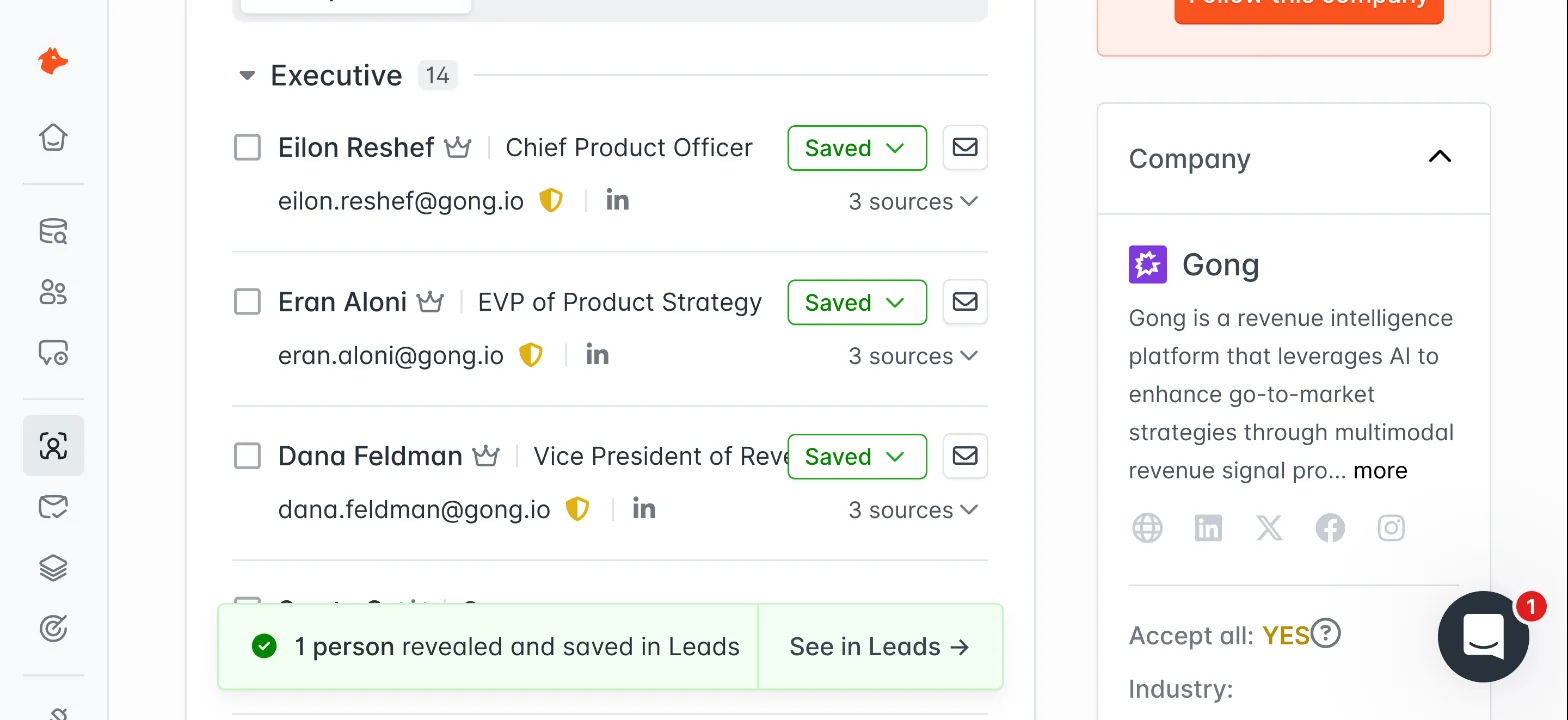
Two things stand out. First, an entire Discover search session costs nothing until you actually pull contacts, so an agent can scope a market for free before spending. Second, duplicate searches within a billing period are not re-billed, so re-running a workflow does not quietly drain the meter: when we re-opened the same gong.io search in the web app afterward, the search itself cost nothing again, and only revealing individual contacts moved the meter, at 1 credit each. The MCP portion of our session consumed 3.7 credits; the full day of testing, web reveals included, closed at 6.9 of the free plan's 50, with the usage page splitting API and website spend so you can audit exactly where each tenth went.
The transparency layer is the real moat
Every result that came back through the MCP carried the same source metadata the web app shows: for each email, the list of public pages where Hunter found it, with the date it was first extracted, the date it was last seen, and a boolean for whether it is still on the page today. One verifier response for a CEO's address listed sources going back to 2022 with their current status. No other finder in this bracket exposes its evidence this way, and for an AI agent the difference is structural: the model can cite why an address is believed correct instead of asserting a score. When your agent is about to put an address into a real campaign, "confidence 85, seen on LinkedIn, last confirmed June 29, still live" is a different quality of answer than "trust me".
The accept-all nuance the scores force you to learn
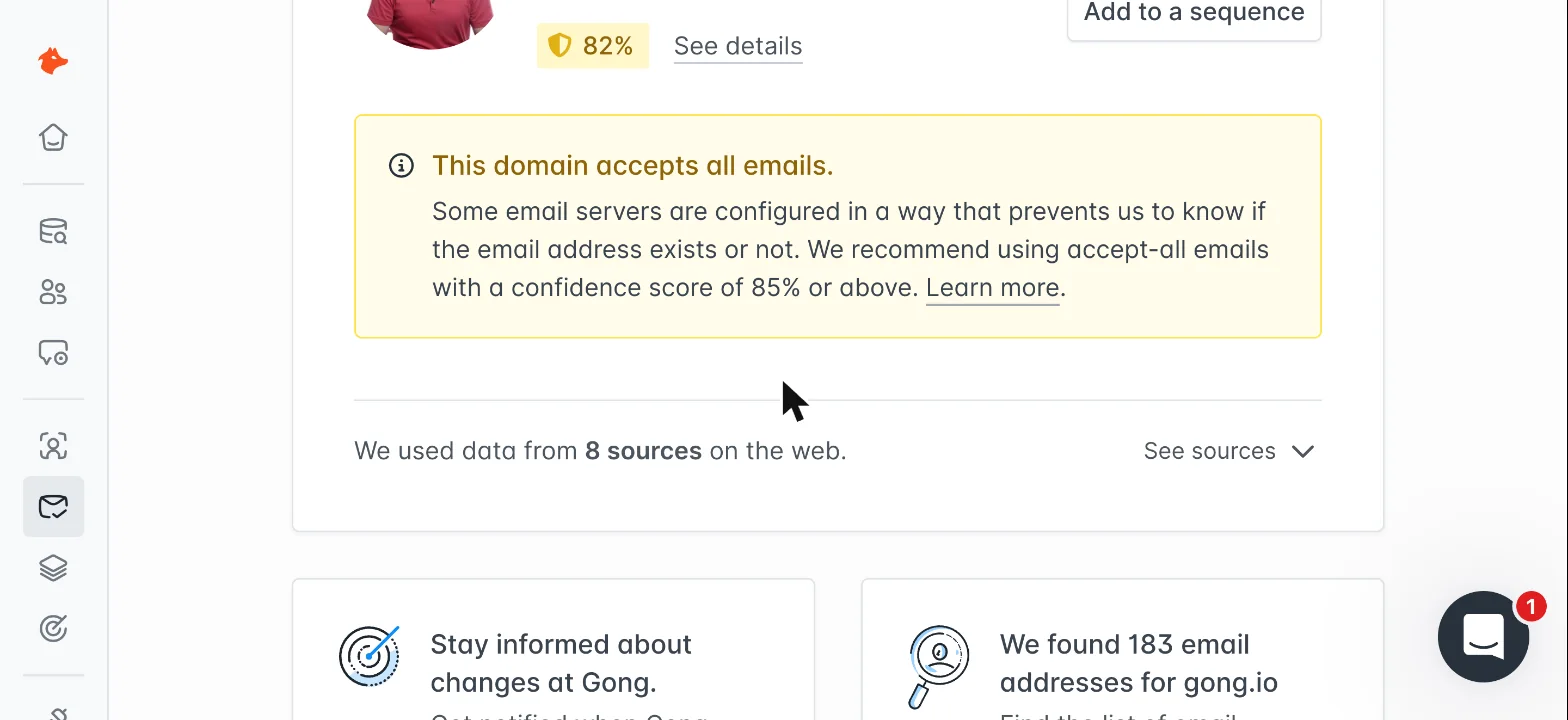
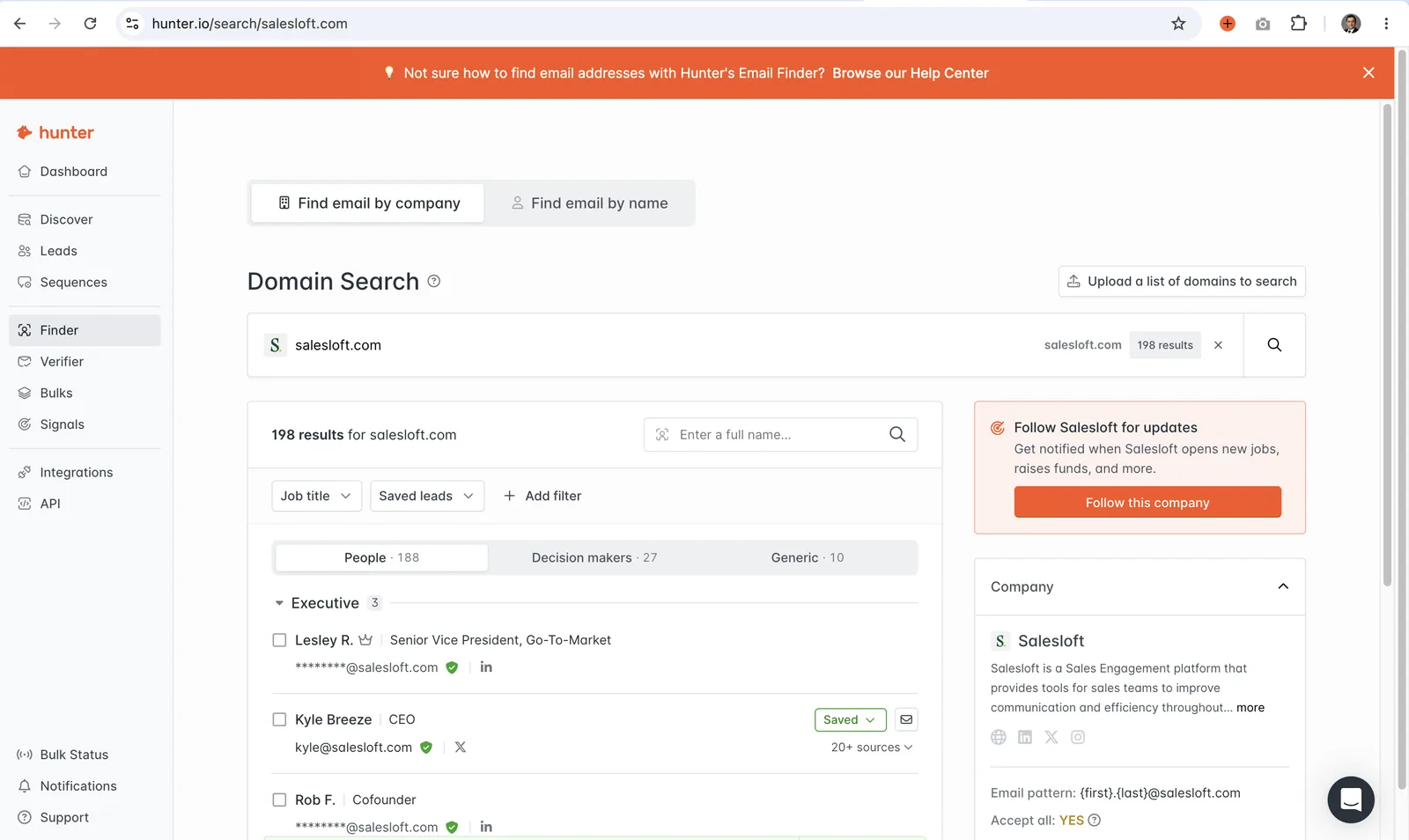
Our test domain (a well-known revenue intelligence company) is configured accept-all, meaning its mail server accepts any address during the SMTP handshake. Hunter handled this exactly right: the domain search flagged the domain accept-all, per-address verification returned "accept_all" status with a score of 82 rather than a false "valid", and the pattern inference ({first}.{last}) plus sources still made the addresses actionable. This is the workflow lesson for any finder: on accept-all domains, no tool on earth can prove deliverability before sending, and a tool that admits that beats one that pretends otherwise. Hunter admits it. In the web app the same check surfaces an amber warning that reads "This domain accepts all emails" and recommends only sending to accept-all addresses scoring 85 or above, which means Hunter's own interface advised caution on the exact address it had just found for us at 82. That is the tool telling the truth against its own sales interest, and it is why we trust the scores. Our catch-all verification guide covers how to handle the amber results.
Where this leaves the competition
For AI-native workflows, the July 2026 scoreboard reads: Hunter 100 tools, lemlist 34, Instantly 0, Smartlead 0. lemlist's MCP is more polished for non-technical setup (OAuth wizard, per-tool permission screens in the product) and reaches deeper into multichannel campaign copy. Hunter's is wider, cheaper to reach (free plan included), and better documented at the tool level, with cost annotations and agent guardrails lemlist does not have. If your prospecting increasingly runs through Claude or ChatGPT, these two are currently the only serious options in the category, and they are complementary: Hunter's MCP for data and list-building, a sender's for the outreach itself.
Core features in detail
Domain Search
Domain Search is Hunter's signature feature. Drop in a company domain and Hunter returns the email addresses it has on record for that organization, organized by department and seniority where it can infer them, each with a confidence score and the sources it found them in. Since 2025 the filters got sharper: a decision-maker flag, job title filtering, department grouping, location, and verification status. In our July 28 test, one search on a mid-size SaaS domain returned named contacts with positions, seniority levels, LinkedIn profiles, the company's email pattern, and a per-address verification state, all in one response. It's the fastest way to map the decision-makers at a target account before you start outreach.
Email Finder
Email Finder is the one-by-one workflow. Give it a person's name and their company domain, or, since October 2025, just their LinkedIn handle, and Hunter returns the single most likely address with a confidence score and the sources behind it. This is the everyday tool for turning a known prospect into a contactable email, and it's where Hunter's pattern inference does its quiet work. The LinkedIn-handle input matters more than it sounds: it removes the copy-the-name-guess-the-spelling step that produced most finder misses in the old workflow.
Email Verifier
The built-in verifier checks an address for deliverability: format validity, gibberish detection, disposable and webmail flags, MX records, and a live SMTP check, returning a status (valid, invalid, or accept_all) and a 0-100 score, at 0.5 credit per check. Bundling the verifier with the finder removes the friction of exporting lists to a separate verification tool, and it's the step that keeps bounce rates down. Two details we confirmed in testing: verification results embed the full source history of the address, and leads saved in Hunter get re-verified monthly for free, which quietly keeps an aging list honest. Even an accurate finder returns some addresses that won't deliver, so verifying before sending is non-negotiable discipline.
Bulk tasks
For volume work, Hunter's bulk uploader takes a CSV of names and companies and returns a finished, scored list, and the bulk verifier does the same for deliverability checks. The bulk path scales to large lists per run, which makes Hunter usable not just for one-off lookups but for building campaign lists in batches.
Chrome extension
The Chrome extension surfaces Hunter on the pages where prospecting actually happens. On a company website it shows the email patterns Hunter has for that domain, and it slots into the LinkedIn and browsing workflow so you can capture a contact without breaking your flow to open a separate tab.
Discover
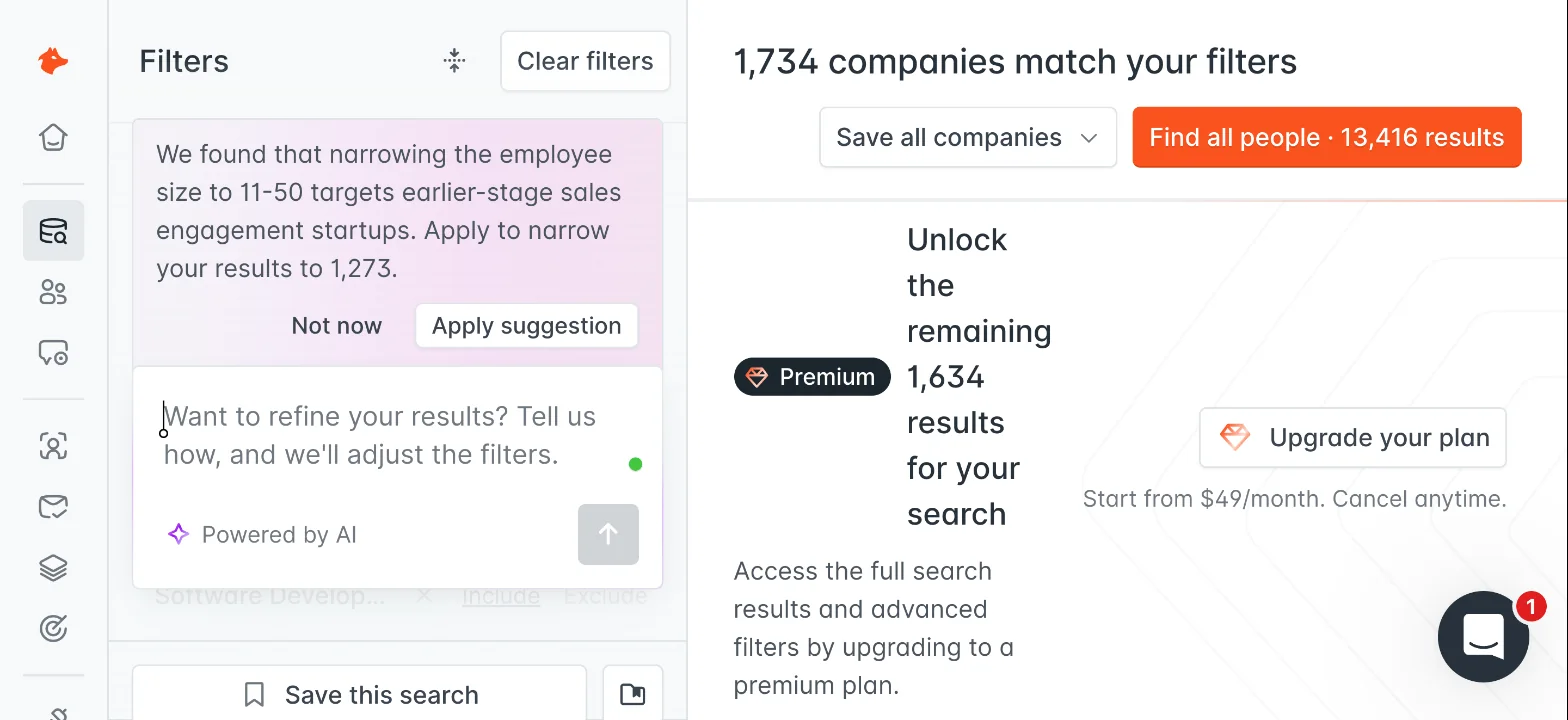
Discover is Hunter's answer to the "I don't know who to target yet" problem, a searchable company database with firmographic filters and, since March 2026, an AI assistant that turns a plain sentence into configured filters. We ran it live on July 28: the sentence "B2B SaaS companies building sales engagement or cold email software, United States, 11-200 employees" became four concrete filters (industry, keyword set with OR logic, two size brackets, country) and returned 1,734 matching companies with a one-click bridge to 13,416 people at those companies. Then it did something we have not seen elsewhere: it read its own results and proposed a refinement, suggesting we narrow to 11-50 employees to target earlier-stage startups, with an Apply button and the resulting count precomputed. A self-refining search beats a filter form as an interaction, plainly.
Know the meters before you lean on it: AI searches are capped at 10 per month on the free plan, browsing results is free, and the free tier shows the first 100 companies of a result set with the rest gated behind a paid plan. The keyword matching also runs literal, so audit the filters it builds (they are visible and editable) before trusting a big number. It is not an Apollo replacement, and it does not claim Apollo's 275M-contact scale, but for scoping a niche market before a campaign it has become a real feature rather than a checkbox.
Sequences (the feature formerly small enough to ignore)
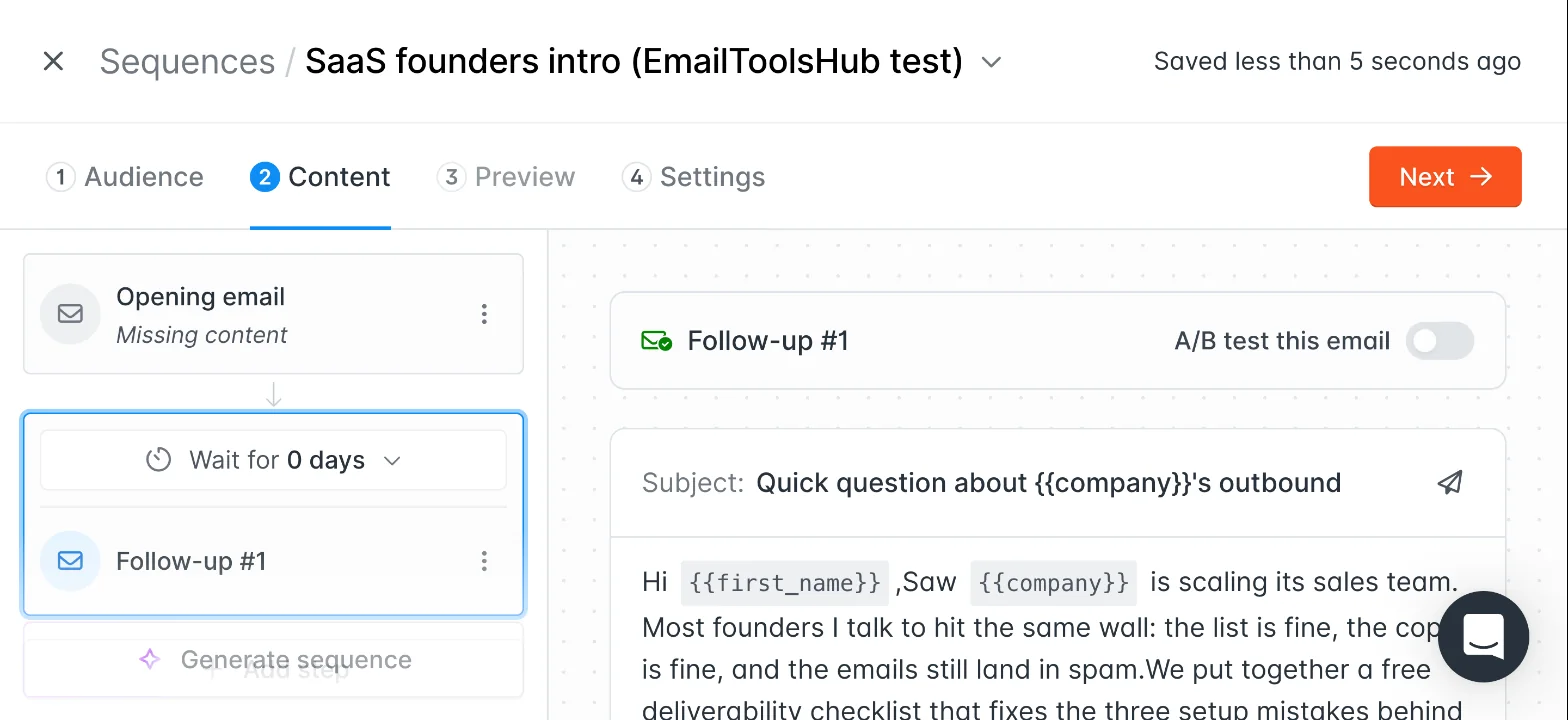
Hunter's sending module has outgrown its old "Campaigns" reputation in three shipping waves. It now does multi-step sequences with scheduling and follow-ups, step-level A/B testing with automatic winner selection, an AI writing assistant, automatic detection of unsubscribes and out-of-office replies, and recipient-based engagement stats. Under it sits the April 2026 infrastructure layer: Hunter will sell you a sending domain, provision inboxes on it with SPF, DKIM, and DMARC configured in about an hour, warm them for 30 days with Inbox Protection, and ramp daily volume progressively based on bounce health. That is most of the checklist people buy a dedicated sender for.
The honest limit is scale. Email accounts are capped at 1 on Free, 3 on Starter, 10 on Growth, and 20 on Scale, with per-sequence recipient ceilings (500 on Free up to 15,000 on Scale). Instantly's whole pitch is unlimited inboxes on a flat price, and Hunter is not trying to match it. Read the caps as positioning: Hunter's sequences are built for operators sending considered volume from a handful of healthy inboxes, not for agencies blasting from forty.
We proved the editor's plumbing in an unusual way: the draft sequence in the screenshot below was created and its step written entirely through Hunter's MCP server, from a chat session, and it appeared in the web editor seconds later with the personalization variables rendered as tokens, the A/B toggle ready, and an AI "Generate sequence" button alongside. Nothing was sent (drafts send nothing, and we left it that way), but the round trip from conversation to editable campaign is real.
API and integrations
Hunter's API is available on every plan, free included, with rate limits generous enough for real workflows (hundreds of requests per minute). It covers search, finding, verification, enrichment, Discover, leads, and sequence management, and October 2025 added dedicated enrichment and company-search endpoints. Beyond the API, Hunter integrates with the major cold email senders (Instantly, lemlist, Apollo, Smartlead, Woodpecker), common CRMs (HubSpot, Pipedrive, Salesforce), Google Sheets, and Zapier, and there is a free company logo endpoint developers can hit without authentication. Because Hunter is standalone rather than locked to one sending platform, it drops into whatever stack you already run, and the MCP server covered above extends the same reach to AI assistants.
Data quality and accuracy
Accuracy is the only thing that matters in a finder, so it's worth being precise. Hunter is among the most accurate dedicated finders on common B2B domains, which is where most small and mid-market outreach lands. The reason to trust it more than a typical all-in-one is the confidence score attached to every result, backed by the public sources Hunter found the pattern in. That lets you make a per-address judgment rather than trusting a blanket vendor claim.
Accuracy still varies by target. Large, established companies with consistent email conventions return cleaner results than tiny startups, very new domains, or international companies with irregular formats. The honest workflow is the same one that applies to every finder: lean on the confidence score, run anything marginal through the verifier, and never push an unverified export straight into a campaign. Treat any "95 percent accuracy" headline, from Hunter or anyone else, as marketing rather than a guarantee you can build a send list on.
One detail that separates Hunter from cheaper finders is transparency. Each result shows the public sources where the pattern was seen, so a result isn't just a score, it's a score you can audit. For high-value targets, that sourcing lets you sanity-check an address by eye before it goes anywhere near a campaign. It's a small feature that compounds, because it shifts the finder from a black box you trust blindly into a tool you can actually reason about.
Hunter for LinkedIn and Sales Navigator prospecting
A large share of B2B prospecting starts in LinkedIn Sales Navigator, and Hunter slots into that workflow through its Chrome extension and Domain Search. The common pattern is to build a target list in Sales Navigator, identify the companies and decision-makers, then use Hunter to turn those names into verified email addresses. On a company website the extension surfaces the patterns Hunter holds for that domain, and Domain Search maps a whole organization at once when you want every relevant contact at a target account rather than one person at a time.
Where this matters is speed. Manually guessing email formats and checking them one by one doesn't scale past a few dozen contacts. Hunter compresses that into a few clicks per account, with a confidence score attached, so a prospector can move from a Sales Navigator list to a verified, sender-ready CSV in one sitting. For teams whose pipeline really starts on LinkedIn, this is the part of Hunter that earns its keep day to day.
See it in action: 18 verified decision-makers across 7 SaaS companies
Rather than describing how this workflow feels, here's a real list built with Hunter in a single session. Our free B2B lead list sample covers 18 verified decision-makers across 7 SaaS sales-tech companies (lemlist, Salesflare, Reply.io, Woodpecker, Snov.io, Close, Lusha). Every contact was sourced through Hunter's Domain Search, checked with the built-in verifier, and structured into a clean sheet with company, title, verified email status, and source. Catch-all domains are flagged amber so the sender knows what needs a second confirmation pass before send.
The point of publishing the sample is transparency. Most vendor demos show the tool working on a curated example. This one shows the tool working on the same companies you'd actually target if you sell to sales-tech buyers, with the same messy reality: some directly verified emails, some catch-all flags, real role coverage across executive, product, sales, and RevOps. If you want to reproduce the list yourself, Hunter's free tier now gives you 50 credits a month (a Domain Search page costs 1 credit, a verification 0.5), enough to hit the same shape on a small ICP without paying.
Step 1: Domain Search on the target companies
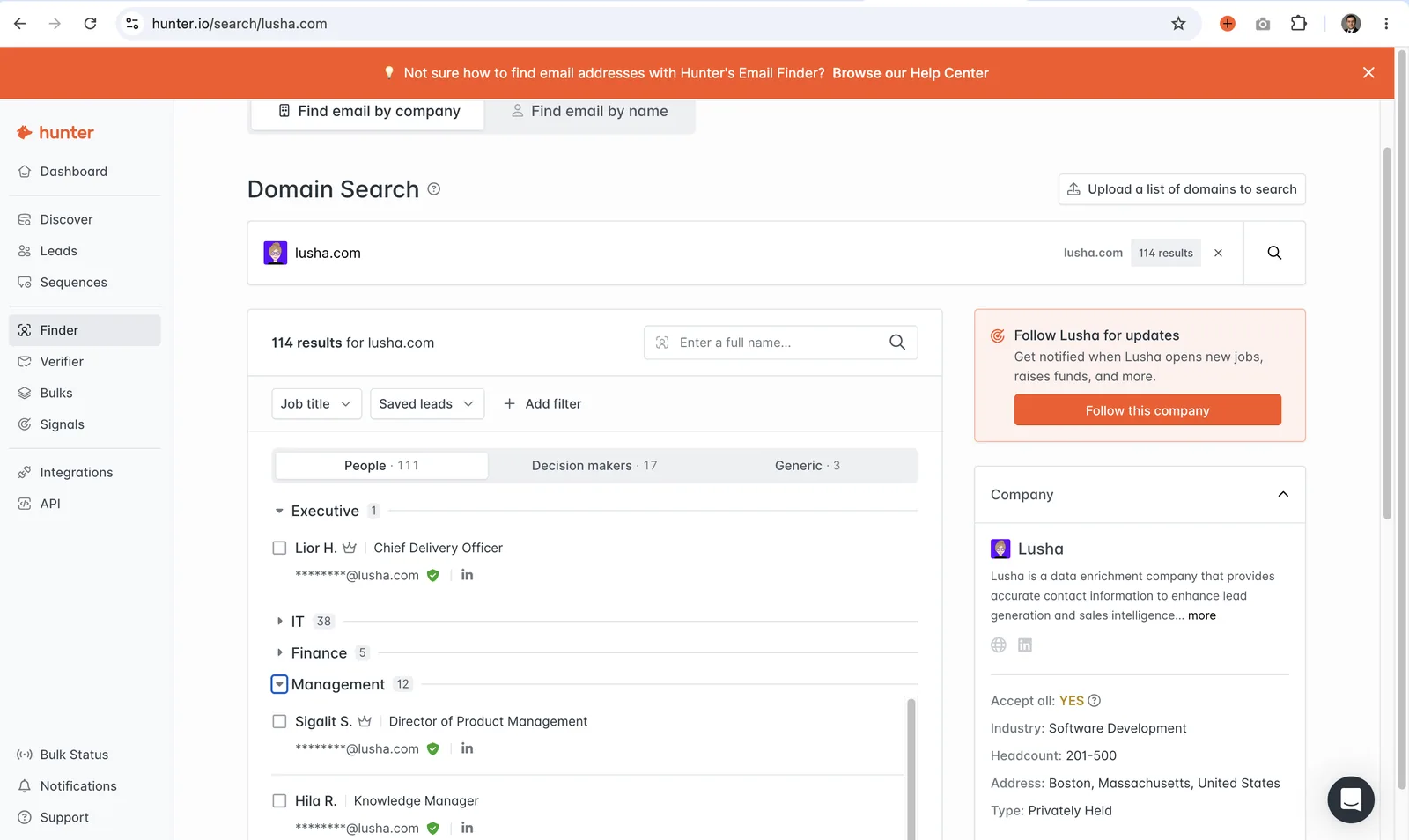
Paste a company domain, Hunter returns every publicly known contact grouped by department (Executive, IT, Sales, Management, RevOps). Two examples: Salesloft (198 results, 27 decision-makers) and Lusha (114 results, 17 decision-makers).
Step 2: Verify each address before sending
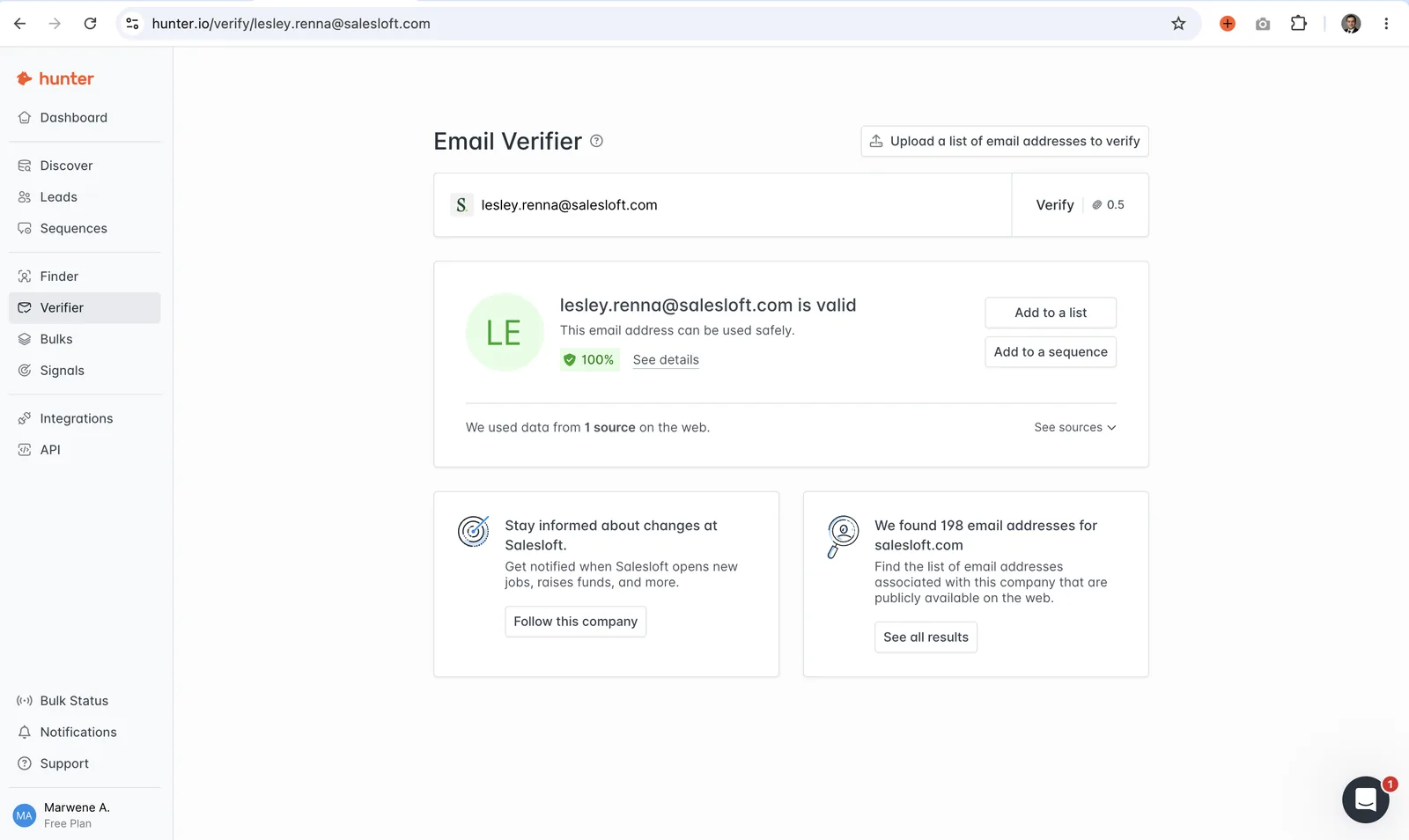
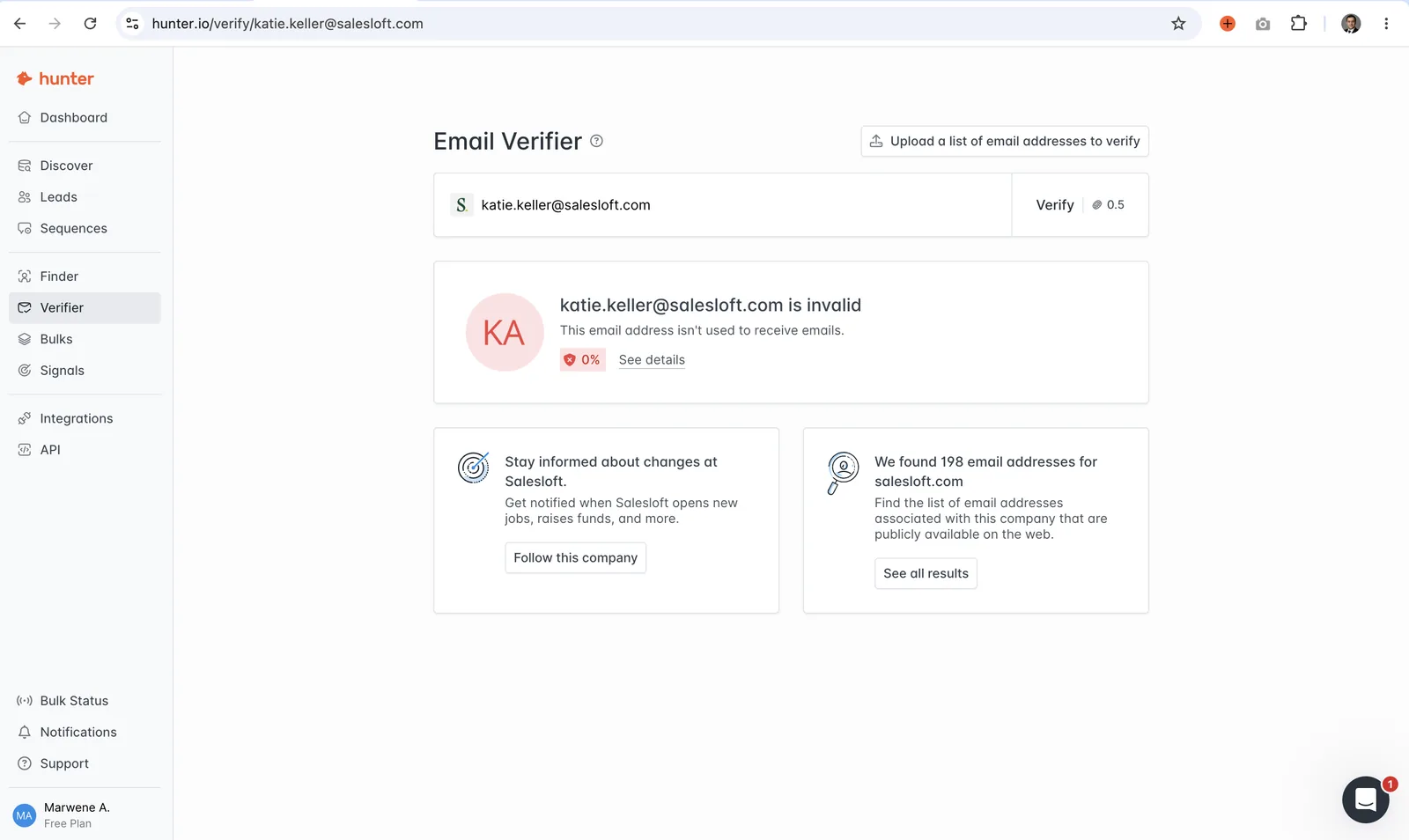
Hunter's verifier tells you if an address is safe to send to. Green means deliverable and confident, red means the mailbox doesn't exist. Send only what's green, drop the red, and Hunter's honesty on the red saves you from a bounce spike that would torch your sender reputation.
Is Hunter's data compliant?
Hunter focuses on professional, business email addresses and publishes its stance on data sourcing and removal requests, which puts it on reasonable footing for B2B outreach. That said, compliance is mostly a workflow question, not a tool question. Using any finder to collect business addresses is generally permitted for legitimate B2B outreach in the US under CAN-SPAM and in the EU under legitimate interest, but the EU bar is higher: your message has to be relevant to the recipient's role, and you need a clear opt-out.
The practical takeaway is that the finder doesn't clear you to send. The rules apply to the outreach, not the data sourcing, and they apply the same whether you found the address with Hunter or by hand. If you operate in or sell into the EU, talk to your legal team about legitimate interest before assuming any tool puts you in the clear. For the operational frame, our deliverability checklist covers the compliance basics alongside the technical setup.
Pricing breakdown by plan
Figures verified against Hunter's live pricing page in September 2026. Yearly billing takes about 30 percent off every tier.
| Plan | Monthly | Annual (per month) | Credits/mo | Email accounts | Recipients per sequence |
|---|---|---|---|---|---|
| Free | $0 | $0 | 50 | 1 | 500 |
| Starter | $49 | $34 | 2,000 | 3 | 2,500 |
| Growth | $149 | $104 | 10,000 | 10 | 5,000 |
| Scale | $299 | $209 | 25,000 | 20 | 15,000 |
| Enterprise | Custom credits, custom features, account manager | ||||
One credit finds one email, verifying costs half a credit, and a repeat search inside the same billing period is free. So a contact taken from unknown to verified costs 1.5 credits, which is the number to size a plan on.
The value question changed shape this year. Starter now bundles the finder, the verifier, three sending inboxes, sequences and warmup, so for a solo operator starting from zero one subscription covers the whole early motion.
The full arithmetic, what each plan really costs per contact, what the free plan gets you and whether yearly billing is worth locking in, sits on a dedicated page: Hunter.io pricing, what every plan really costs per contact.
Verify the current pricing on the official Hunter site before subscribing. Plans and prices can change.
Check Current Pricing on Hunter →
Hunter vs Snov.io vs Apollo
These three are the usual shortlist for a finder buyer. The quick framing: Hunter is the focused dedicated finder, Snov.io is the budget bundle that adds a verifier and a light sender, and Apollo is the database-first all-in-one.
| Criterion | Hunter | Snov.io | Apollo |
|---|---|---|---|
| Free tier | 50 credits/mo | 50 credits/mo | Free plan (50 credits) |
| Starting price | $49/mo ($34 annual) | $39/mo | $49/mo |
| Database size | 100M+ verified emails | 700M+ profiles | 275M+ contacts |
| Built-in sender | Yes (Sequences + managed inboxes, capped per plan) | Yes (drip) | Yes |
| Built-in verifier | Yes | Yes (7-step) | Yes |
| Warmup included | Yes (Inbox Protection, 30-day) | Yes (add-on slots) | No native warmup |
| MCP for AI assistants | Yes, 100 tools | No | No |
| Best for | Accurate finding + light sending | Budget bundle | Database + sending |
Hunter vs Snov.io
Both sit in the same shopping cart, and the decision comes down to whether you want a sender bundled in. Snov.io includes drip campaigns and a seven-step verifier, so it's the cheaper one-tool bundle for finding, verifying, and light sending. Hunter is more focused, with a cleaner interface and slightly stronger pattern inference on edge-case domains, but it expects you to bring your own sender. Pick Hunter when finding accuracy and integration with an existing sender matter most. Pick Snov.io when you want the budget all-in-one. For the full head-to-head on accuracy, verification, pricing, and the Chrome extension, see our dedicated Hunter vs Snov.io comparison, or the Snov.io review and email finder comparison.
Hunter vs Apollo
These two are aimed at different buyers. Apollo is database-first: 275M plus contacts with phone numbers, technographics, and intent signals, plus a sender and CRM. If your bottleneck is discovering the right accounts in the first place, Apollo's database is unmatched in this bracket. Hunter is finder-first. You arrive already knowing who you want to reach, and you need the right address, verified, fast. If you're building target account lists from scratch, Apollo wins. If you're turning known prospects into deliverable contacts, Hunter is tighter and cleaner.
Hunter Sequences vs a dedicated sender: where the line is now
This section needed a rewrite, because the line moved. Through 2025 the honest advice was that Hunter's sending feature lacked the machinery that keeps volume cold email out of spam: no warmup, no rotation, no health analytics. As of mid-2026 that list is mostly wrong. Hunter provisions managed inboxes with authentication configured, warms them for 30 days, ramps volume progressively against bounce health, scores account health in a dedicated center, A/B tests sequence steps, and handles unsubscribes and out-of-office replies automatically.
What still separates a dedicated sender is depth of rotation and the economics of scale. Instantly's flat price covers unlimited sending accounts and its warmup network is its core asset; Hunter caps accounts per plan (3 on Starter, 10 on Growth, 20 on Scale) and prices credits for data on top. The practical rule has shifted from a volume threshold to an inbox threshold. If your motion runs comfortably from a handful of inboxes at considered volume, Hunter's Sequences will carry it end to end, and one subscription replaces two. The moment your strategy depends on many rotating inboxes and domains, the sending job belongs to a dedicated tool while Hunter stays upstream as the finder. Burning a clean domain by over-driving any single inbox remains the one mistake no feature update forgives.
How Hunter fits in the stack
The cleanest way to think about Hunter in 2026 is as the front of an outbound stack that can now also be the whole small stack. Hunter finds and verifies the addresses; either its own Sequences send them from a few managed, warmed inboxes, or a dedicated sender like Instantly handles rotation at volume downstream, connected by CSV export or native integration. The decision point is inbox count, not features. A CRM or spreadsheet catches the replies either way, and the MCP server means both halves are drivable from an AI assistant if that is how you work. For the sending half of the equation at scale, see our best cold email software guide, and for the rules that keep those emails landing, the deliverability checklist. Get those two pieces right around a clean finder and the rest of the stack mostly takes care of itself.
Common mistakes operators make with Hunter
Three patterns show up repeatedly:
Skipping verification because the finder feels confident. A high confidence score is a probability that the pattern is right, not a guarantee the inbox exists. Run finder output through the verifier before it enters a campaign, especially anything below a strong confidence score.
Over-driving a small inbox setup. Sequences plus managed inboxes handle real outreach now, but three warmed inboxes are still three inboxes. Operators who treat the new sending layer as license to blast volume through it re-learn the oldest deliverability lesson in the book. Respect the progressive ramp, keep per-inbox volume boring, and add inboxes or a dedicated sender before you add aggression.
Ignoring the confidence score on hard domains. On tiny, new, or international domains, accuracy drops. Operators who treat every result as equally reliable end up with bounces. Read the score, and treat low-confidence results on hard domains as leads to verify, not addresses to send.
Pros and cons
Pros
- Clean, focused interface with almost no learning curve
- Strong accuracy on common B2B domains, with a confidence score and auditable public sources on every result
- Built-in verifier at 0.5 credit per check, plus free monthly re-verification of saved leads
- Sequences with A/B testing, managed inboxes, 30-day warmup, and progressive sending, all included on paid plans
- One transparent credit meter: 1 credit per found email, 0.5 per verification, duplicates free
- The deepest MCP integration in the category (100 tools), plus API access on every plan, free included
- Integrates with every major sender, so it also fits any existing stack
- Usable free tier (50 credits/mo) for testing before you commit
Cons
- Email accounts capped per plan (1 to 20), so agency-scale rotation still needs a dedicated sender
- Discover is useful for scoping but no Apollo: smaller pool, and its AI search matches keywords a bit literally
- Thinner on enterprise C-suite and phone data than RocketReach
- Accuracy drops on small, new, or international domains, as with any finder
- Monthly billing at $49 stings; the real price is the $34 annual rate
- MCP setup is API-key based: quick, but the key carries full account authority with no per-tool permission screen
TL;DR
- Our score: 9.2/10, raised from 9.0 after the July 28 hands-on session
- Pricing sweet spot: Free plan (50 credits/mo) to test, then Starter at $34/mo billed annually for ongoing prospecting plus first sequences
- Best for: Operators who want accurate, auditable finding and verifying, with enough sending built in to carry a small motion
- Skip if: You need many rotating inboxes (Instantly), the cheapest bundle (Snov.io), or a discovery database to build lists from scratch (Apollo)
- AI-native note: Hunter's MCP server exposes 100 tools to Claude and ChatGPT, the deepest in the category as of July 2026
- Signup note: One email, no company website required, so solo founders can start immediately
Operator note
If finding and verifying emails is the job, Hunter is the tool we'd reach for first, and after a month of watching it through both the web app and the MCP server, the reason has sharpened. It isn't just accuracy. It's that Hunter shows its work: every address arrives with a score, the public sources behind it, and the dates it was last seen alive. When your reputation rides on what you send, auditable beats confident.
The 2026 version of the buying advice splits by where you are. Already running Instantly or another sender? Hunter stays exactly what it was, the cleaner upstream half of the stack, now easier to drive from Claude or ChatGPT than any competitor. Starting from zero as a solo operator? Try the motion Hunter clearly designed this year: Starter plan, one managed inbox warmed by Inbox Protection, find and verify 30 prospects, run one considered sequence, and only add tools when the caps pinch. The budget-constrained operator who needs maximum volume per dollar should still price out Snov.io's bundle. Everyone else gets more honesty per credit here than anywhere in the category.
Bottom line
Hunter is the cleanest email finder in 2026, and this year it became more than that without becoming worse at its job. The finding is accurate on the domains most B2B operators actually target, every result is honest about its confidence and its sources, the new sending layer is real enough for a small motion, and the 100-tool MCP server makes it the most AI-ready data tool in cold email. The remaining trade-offs are deliberate: capped inboxes instead of Instantly's unlimited rotation, a scoped database instead of Apollo's, a fair price instead of Snov.io's cheapest one. If accurate, auditable contact data is the core of what you need, Hunter is the category benchmark and the free tier's 50 credits are enough to prove it on your own targets.
Frequently asked questions
Is Hunter.io better than Snov.io?
For pure email finding, Hunter is usually the sharper tool. It does one job, the interface reflects that, and pattern inference on edge-case domains tends to be slightly stronger. Snov.io wins when you also want a verifier and a basic sender bundled in the same subscription. Pick Hunter if finding and verifying emails to feed an existing sender is the whole job. Pick Snov.io if you want the budget all-in-one bundle. See the full finder comparison for the side-by-side.
Is the Hunter free plan good enough?
For testing and very low-volume use, yes, and it got more generous: the free plan now includes 50 credits a month, one connected email account, and sequences capped at 500 recipients. Since finding an email costs 1 credit and verifying costs 0.5, that's roughly 30 found-and-verified contacts a month at no cost, enough to validate whether Hunter's data quality fits your targets. API and MCP access work on the free plan too. For ongoing prospecting, most operators move to Starter, which lifts the meter to 2,000 credits.
How accurate is Hunter's email finder?
Hunter is among the more accurate dedicated finders on common B2B domains, and every result carries a confidence score so you can judge it before sending. Accuracy still varies by domain, with large established companies returning cleaner patterns than tiny or international ones. Treat any vendor accuracy headline as marketing, lean on the confidence score, and run lower-confidence results through verification before they enter a campaign.
Does Hunter send cold email?
Yes, and better than its old reputation suggests. Hunter's Sequences module does multi-step sequences with A/B testing, an AI writing assistant, and automatic unsubscribe and out-of-office handling, and since April 2026 Hunter provisions managed sending inboxes with SPF, DKIM, and DMARC configured, 30-day automated warmup, and progressive volume ramp-up. The limit is scale: email accounts are capped per plan (1 to 20), so a handful of healthy inboxes is the design point. For volume across dozens of rotating inboxes, pair Hunter's data with a dedicated sender such as Instantly.
Does Hunter verify email addresses?
Yes. Hunter includes a built-in email verifier alongside the finder, so you can check deliverability without moving lists into a separate tool. The verifier checks format, domain records, and the mail server, and returns a status plus a confidence score. The disciplined workflow is to verify before sending, since even a strong finder returns some addresses that will bounce.
Does Hunter integrate with cold email tools?
Yes, and this is one of Hunter's biggest strengths. It integrates cleanly with every major cold email sender, including Instantly, lemlist, Apollo, Smartlead, and Woodpecker, plus CRMs and Google Sheets, and it offers API access on paid plans. Because Hunter is standalone rather than tied to one sender, you can pair it with whatever sending stack you already run.
How much does Hunter cost?
As of July 2026: the free plan includes 50 credits a month, Starter is $49 monthly or $34 per month billed annually with 2,000 credits, Growth is $149 or $104 annually with 10,000 credits, and Scale is $299 or $209 annually with 25,000 credits, with an Enterprise tier above that. One credit finds one email, half a credit verifies one, and duplicate searches in a billing period are free. Plans and prices change, so verify the current numbers on Hunter's official pricing page before subscribing.
Do I need a separate sending domain when using Hunter?
Yes, but that is a sending rule, not a Hunter rule. Hunter finds and verifies the addresses. The sending domain matters at the next step, when you load that list into a sender. Always send cold email from a dedicated domain rather than your main company domain, so that any reputation damage stays isolated from your transactional and marketing email. See our deliverability checklist for the full setup.
Is Hunter worth it in 2026?
For anyone who needs a reliable finder plus verifier, yes, and the free plan's 50 monthly credits let you confirm the data quality on your own targets before paying. The 2026 additions widen the answer: Starter now bundles sequences, managed inboxes, and warmup, so a solo operator can run the whole early outbound motion on one subscription. The value is weaker if you need maximum volume per dollar, where Snov.io's bundle is cheaper, or if you need to discover prospects from scratch, where Apollo's database does more for the money.
Does Hunter work with Claude and ChatGPT?
Yes, through an official MCP server that we tested hands-on in July 2026. It exposes 100 tools covering search, finding, verification, enrichment, Discover, leads, and full sequence management, so an AI assistant can run a prospecting workflow end to end in conversation. Setup is one URL plus your API key, works on the free plan, and the tools carry built-in guardrails: destructive operations are restricted, and starting a sequence requires an explicit user go-ahead. As of July 2026 it is the deepest MCP integration in the cold email category; lemlist ships 34 tools, Instantly and Smartlead none.
Does Hunter include email warmup?
Yes, since April 2026. Inbox Protection warms new email accounts automatically over about 30 days to build sender reputation before real campaigns, and Progressive Sending then ramps daily volume gradually based on bounce health. Hunter can also sell you a sending domain and provision the inboxes itself with SPF, DKIM, and DMARC configured, typically ready within an hour. Warmup applies to the email accounts on your plan, which are capped by tier, so it covers a small healthy setup rather than an agency-scale rotation pool.
Is Hunter or Apollo better for finding leads?
They do different jobs. Hunter is a finder-plus-verifier: you bring a name and company, it returns the accurate address. Apollo is a discovery database: you filter hundreds of millions of contacts to build a list from nothing. If you already know who you want and need clean addresses, Hunter is sharper and its per-address accuracy tends to be higher. If your bottleneck is finding who to target in the first place, Apollo's database wins. Many operators use Apollo to build the list and a finder like Hunter to clean or verify it.
Next steps
If Hunter fits your situation, start with the free tier and run 25 to 50 lookups on your own targets to judge the data quality before paying. For the wider context on where Hunter sits in the category, see our broader email finder comparison, the Snov.io review for the budget-bundle alternative, and the best cold email software guide for the sender to pair it with. For how we review tools, see our methodology.

About the author
Marwene Amor · Founder @ EmailToolsHub
I review B2B cold email tools as an independent operator, testing the products myself and writing the honest version of what I find. More about me or connect on LinkedIn.
Related Reviews & Guides
Other deep dives on EmailToolsHub that pair well with this one.
Best Email Finder Tools 2026
How Hunter stacks up against Snov.io, Apollo, Findymail, and RocketReach.
Read it →Snov.io Review 2026
The budget bundle alternative: finder plus verifier plus light sending in one tool.
Read it →Best Cold Email Software 2026
Pair Hunter's verified emails with the right sender for outreach at scale.
Read it →